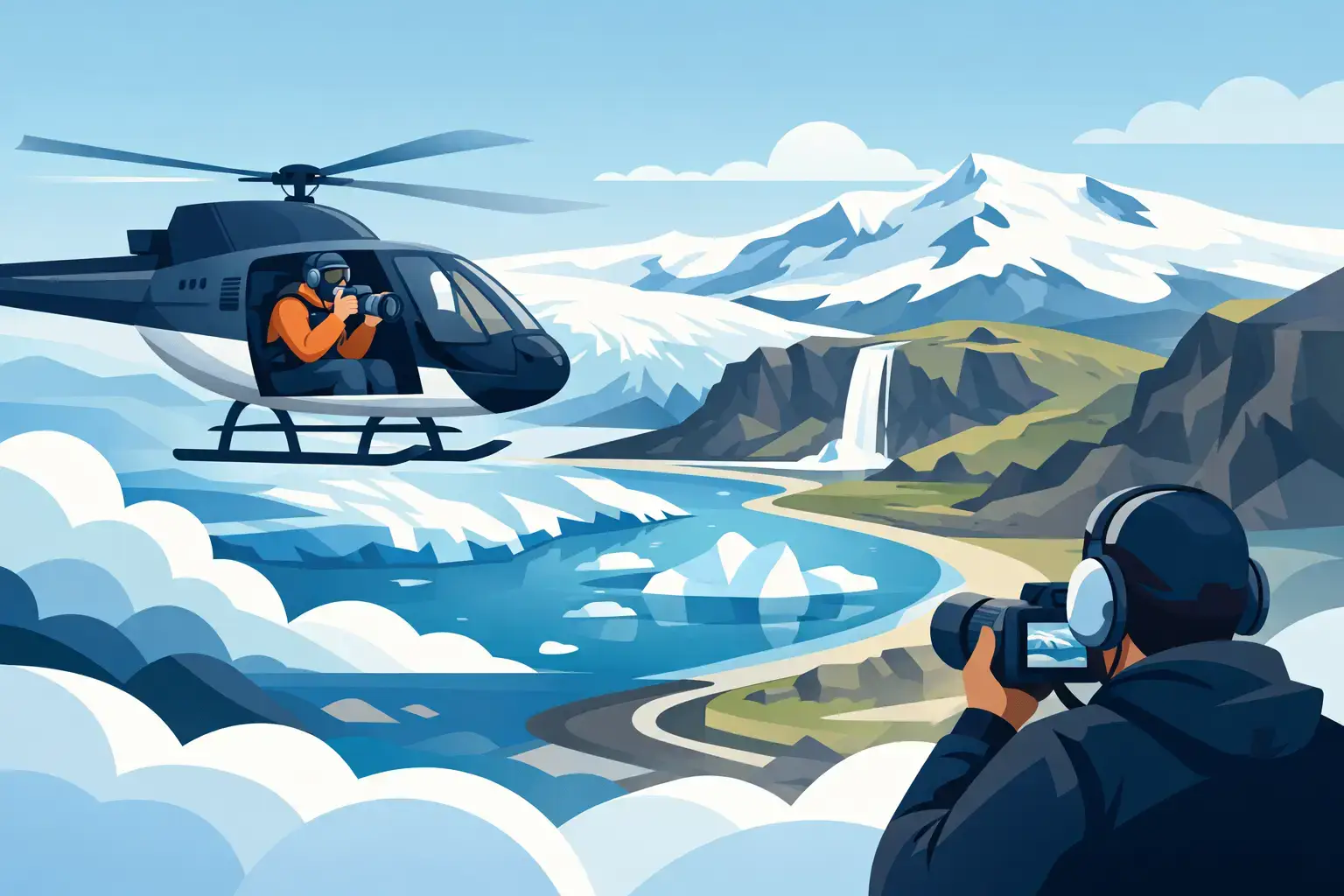
A good Iceland photo from the ground usually starts with patience. A great one from the air starts with access. When people search for helicopter photography Iceland, they are usually not looking for a novelty flight. They want angles that roads cannot deliver, light that changes by the minute, and a way to reach glaciers, volcanoes, black sand coasts, and highland rivers without spending half the day getting there.
That is the real appeal of shooting Iceland by helicopter. You trade long overland transfers for time in the air and time on location. For photographers, that changes everything. It means more flexibility around weather windows, more control over perspective, and the chance to build a flight around the landscapes that matter most to your portfolio.
Why helicopter photography in Iceland stands apart
Iceland is built for aerial work. The terrain is dramatic at every scale. From above, braided rivers look like silver threads across volcanic plains. Glacial crevasses turn into abstract patterns. Waterfalls that feel vertical from the ground reveal their full shape when seen from the side or slightly above. Even familiar landmarks become different subjects once altitude, direction, and light are working in your favor.
But the same conditions that make Iceland visually extraordinary also make it demanding. Weather moves fast. Light can be flat one hour and perfect the next. Wind matters, and so does season. In winter, low sun can add depth all day long, but access and conditions are tighter. In summer, you get generous daylight and huge route options, though midday light can be harsher than many photographers expect.
This is why helicopter photography is less about simply getting airborne and more about planning the right flight. The best results come when the aircraft, route, landing options, and timing all support the images you want to make.
Planning helicopter photography Iceland around the shot list
The first question is not which helicopter to book. It is what you want to photograph. Some photographers want wide scenic frames of glaciers and mountain ridges. Others want tight volcanic textures, waterfall systems, or a black sand coastline under low-angle light. Those priorities shape the route, flight duration, and whether you need a scenic overflight or a custom charter with landings.
If your goal is variety, a longer flight often makes more sense than trying to force too much into a short window. Iceland’s landscapes are spread out, and even from the air, distance matters. A 90-minute experience can be excellent for a focused region. A longer custom itinerary is better if you want a fuller aerial portfolio with distinct terrain types in one day.
Landing capability also changes the photography. Shooting through an open or closed aircraft door creates one type of image. Stepping onto a remote ridge or beside a glacier edge creates another. Ground access at a private landing site gives you stable compositions, room to change lenses, and the chance to work the scene rather than racing past it.
What makes the best aerial subjects in Iceland
Not every famous destination is best from a helicopter. Some are more impressive on foot. Others become extraordinary only when viewed from above. Glaciers are one of the clearest examples. Their scale is difficult to understand from the ground, but from the air, the flow lines, icefalls, and ash-streaked surfaces become visually legible.
Volcanic terrain is another strong match. Recent lava fields, crater systems, geothermal color, and fissure patterns often read better from altitude than they do at eye level. Highlands routes can be especially rewarding because they combine rivers, rhyolite mountains, mossy plateaus, and isolated roads that emphasize how remote the landscape really is.
Waterfalls can go either way. Some are iconic from established viewing areas, but from a helicopter they gain context. You see the river feeding them, the canyon below, and the surrounding topography in one frame. That broader composition is often what turns a beautiful photo into a memorable one.
Gear choices that work in the air
For most helicopter photography in Iceland, less gear is better. You do not need your full kit in the cabin. You need a camera setup that you can handle quickly and confidently in a moving aircraft with changing light. Two camera bodies can be useful, but only if you are comfortable managing them safely and efficiently.
A wide-to-mid zoom is usually the workhorse lens. It gives you enough width for landscapes while still allowing some compression of ridgelines, glaciers, and river systems. A second lens with moderate reach can help for isolating textures, but very long lenses are often harder to use in the aircraft and less practical in variable conditions.
Fast lens changes are not always realistic, especially if doors are off or space is limited. That is one reason many experienced aerial photographers keep their setup simple. Clean front elements, secure straps, and good battery discipline matter more than carrying every possible focal length.
Polarizers are a mixed decision. They can help in some situations, especially with glare, but they also reduce light and can create uneven effects in very wide scenes. It depends on the lens, the angle to the sun, and whether you are shooting through glass. Neutral density filters are generally less useful unless you have a very specific creative plan during a landing.
Shooting technique inside the aircraft
Aerial photography rewards small technical choices. Shutter speed is one of the most important. Even if the helicopter is stable, you are still working in motion, and Iceland’s weather can add vibration or wind. In practice, faster shutter speeds give you more keepers.
If you are photographing through windows, managing reflections becomes part of the job. Dark clothing helps. So does paying attention to your angle relative to the glass. If the flight allows open-door shooting, image quality improves, but so do the demands on technique and gear security. You want every loose item controlled before takeoff.
Communication with the pilot matters more than many first-time photographers expect. Pilots familiar with aerial sightseeing and photo work understand how to present a subject, make a gradual turn, or pass a feature from the better side based on light. That only helps if they know what you are trying to capture. A clear pre-flight conversation about priorities often produces better images than any piece of equipment.
Weather, light, and the value of flexibility
Iceland rarely rewards rigid plans. The best helicopter photography sessions often happen because the schedule has room to adapt. If cloud cover is sitting on one glacier system, another route may be open and spectacular. If wind limits one landing area, a different destination may offer stronger conditions and equally strong imagery.
This is where working with a local operator makes a real difference. Experience is not just about flying safely. It is about understanding how Iceland behaves on a given day, which routes suit the weather, and when waiting an hour can transform the light. HeliAir, for example, operates from more than one base and builds both structured tours and custom helicopter itineraries around exactly that kind of on-the-ground reality.
For photographers visiting Iceland on a tight schedule, this flexibility is often the difference between getting a nice scenic flight and getting images worth the trip.
Is a tour or a custom charter better?
It depends on your goal. A scenic tour can be ideal if you want a premium aerial experience and strong images without needing full control over the route. It is efficient, well-planned, and often enough for travelers who want to photograph a specific region in good light.
A custom charter is the better fit when photography is the main purpose of the flight. That is especially true for professionals, production teams, serious enthusiasts, or private groups with specific locations in mind. Custom planning gives you more say over timing, route logic, landings, and how long to spend at each location.
There is also a budget trade-off. A tailored helicopter photography day in Iceland is a premium product. But for many travelers, the value is obvious. You are not paying only for flight time. You are paying for access, efficiency, and the ability to design a day around Iceland’s most difficult variable – conditions.
Getting the images you came for
The strongest aerial photography in Iceland usually comes from restraint. Pick a few target landscapes. Build around the weather. Leave room for route changes. Bring the gear you will actually use well. And choose a flight plan that treats photography as the point, not as an afterthought.
Iceland gives very little that feels ordinary from the air. If you plan carefully, stay flexible, and fly with people who know the terrain, the camera has a way of taking care of the rest.