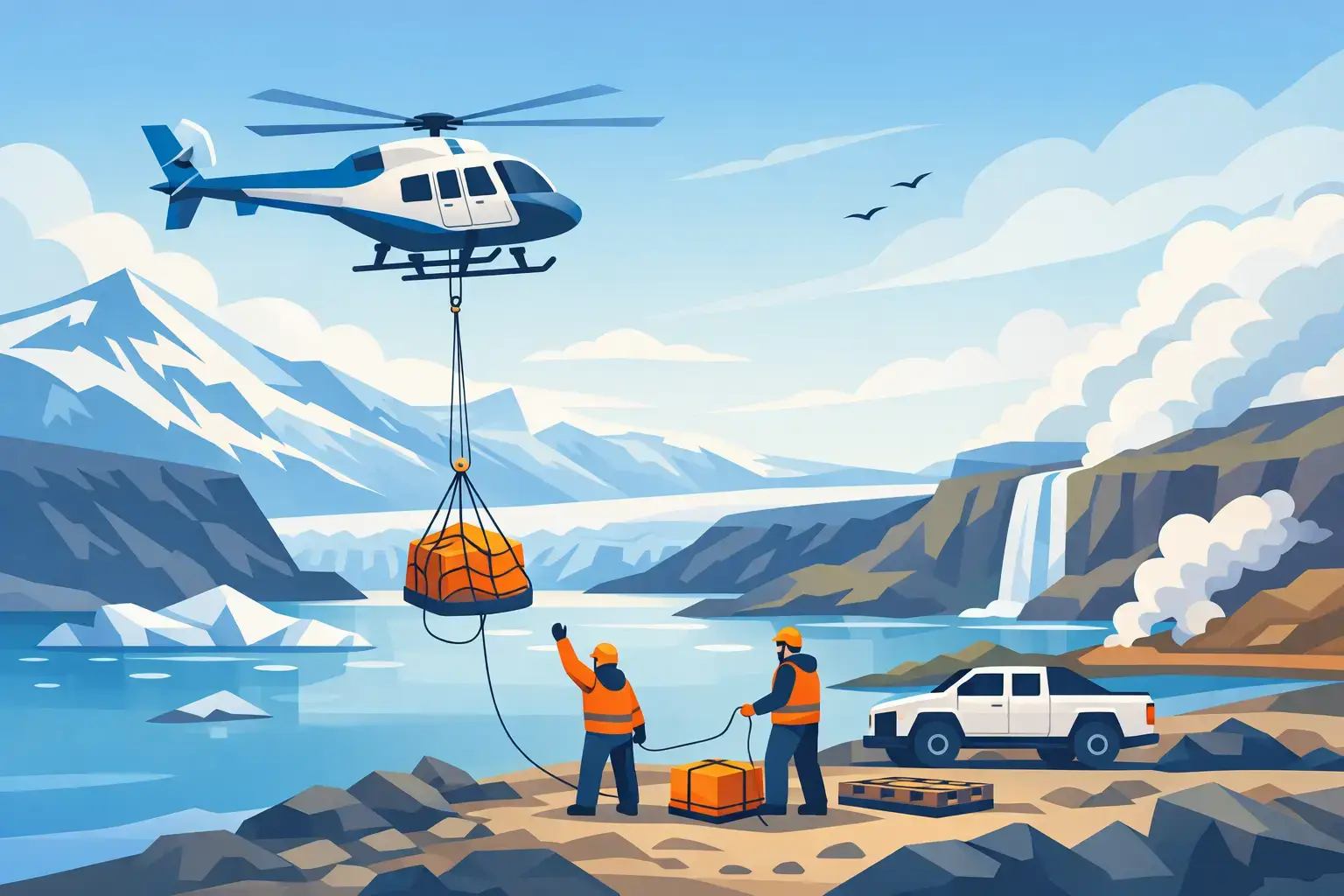
A steel tower section hanging beneath a helicopter over black sand, lava fields, or a narrow mountain ridge is not a sightseeing moment. It is precision work. Helicopter sling work in Iceland is used when ground access is slow, impossible, or simply too disruptive for the job at hand. For utility crews, construction teams, researchers, and production support, it is often the cleanest way to move equipment into places where roads end and terrain takes over.
Iceland is exceptionally well suited to this kind of operation, and also exceptionally demanding. Distance is only part of the equation. Weather shifts quickly, wind funnels through valleys, landing zones can be limited, and many sites sit on terrain that looks open from a map but works very differently in real conditions. That is why sling operations here are less about brute lift and more about planning, timing, and local flight judgment.
What helicopter sling work in Iceland is used for
Sling work means carrying an external load suspended beneath the aircraft. That load might be construction materials, utility components, tools, fuel, camera gear, scientific equipment, or specialized supplies for remote operations. In Iceland, the use cases are broad because the country has so many areas where overland transport is inefficient or not viable.
A mountain communications site may need replacement hardware without sending a convoy across rough tracks. A remote lodge project may need building materials delivered where heavy vehicles would damage fragile ground. A production crew may need technical equipment positioned near glaciers, waterfalls, or highland locations with minimal setup time. In each case, the helicopter is not just transport. It is a logistics solution that compresses distance and reduces the ground footprint of the project.
That does not mean a helicopter is always the cheaper option. If a site is accessible by road and the timing is flexible, ground transport can make more sense. Sling work becomes attractive when the value of speed, access, and reduced site disruption outweighs the cost of mobilizing aircraft and crew.
Why Iceland changes the way sling work is planned
Iceland rewards aerial access, but it does not forgive assumptions. Jobs that look simple on paper can become more technical because of wind, elevation, surface conditions, or the lack of suitable staging areas. A lift near the coast may deal with salt exposure and gusting conditions. A highland job may involve soft ground, changing visibility, and long positioning legs. Glacier-adjacent work adds another layer of caution around airflow, temperature, and terrain effects.
This is where local operating knowledge matters. The question is rarely just, Can the helicopter lift it? The better question is, Can the load be lifted safely from this pickup point, flown on this route, and placed accurately at this destination under today’s conditions? Weight, shape, rigging, balance, and weather all interact. Iceland’s environment makes that interaction more pronounced.
Season also matters. Summer opens more project windows in the highlands, but it can also bring heavy demand for aircraft and tight scheduling. Winter may suit some technical operations, especially when frozen ground improves site conditions, yet daylight and weather can narrow the available flight period. There is no universal best month. It depends on the site, the load, and how much flexibility the project can tolerate.
The loads that make sense for sling operations
Not every item is a good sling load. The best candidates are well understood, properly rigged, and sized for clean handling in flight. Materials such as lumber bundles, tower parts, generators, fuel containers, fencing supplies, and pre-packed equipment loads are common examples. Awkward loads can still be moved, but they require more preparation and often more conservative operating limits.
Shape matters as much as total weight. A compact, balanced load is usually easier to manage than a lighter object with a poor center of gravity or high wind resistance. If a load can spin, shift, or catch airflow, the plan has to account for that. In practical terms, this often means spending more time on packaging and rigging before the first flight. That time is well spent. Better preparation on the ground usually leads to a faster and safer operation in the air.
For clients, one of the most useful early steps is simple documentation. Dimensions, estimated weight, photos, pickup conditions, and delivery conditions help define whether the job is straightforward or highly specialized. That is especially true in Iceland, where a small detail on the ground can have an outsized effect on how the mission is flown.
How a helicopter sling work project is typically organized
Most successful sling work starts long before the aircraft lifts off. The planning phase usually focuses on four things: the load, the site, the route, and the timing. The operator needs to understand exactly what is being moved, how it will be rigged, where it will be picked up, and what the drop zone looks like in real operating conditions.
A site survey may be needed, either in person or through detailed imagery and client briefing. That helps identify hazards such as wires, uneven ground, rotor wash sensitivity, limited approach paths, or the need for staging space. In Iceland, route planning also has to account for terrain funnels and weather patterns that can differ sharply over short distances.
On the day of operation, efficiency depends on coordination. Ground crews need clear roles. Loads should be staged and ready. Communication protocols should be established in advance. If the project involves multiple lifts, the pace of the work is usually determined less by flight time alone and more by how cleanly each pickup and set-down can be turned around.
This is another area where there are trade-offs. A rushed site setup can create delays later. A well-organized staging area may cost more labor upfront but save aircraft time across the whole operation. Since helicopter hours are valuable, good ground discipline is often the difference between a tidy project and an expensive one.
Safety, weather, and operational limits
Premium service in aviation is not about promising yes to every request. It is about knowing when conditions support the mission and when they do not. Sling work places more variables into the operation than a standard passenger flight, so weather decisions are especially important.
Wind is one of the biggest factors. Even when visibility looks fine and the route is flyable, gusts at the pickup or destination point can make external load work unsuitable. Cloud base, precipitation, and localized terrain effects also matter. Iceland can produce very different conditions within the span of one job, especially when operating between lowland staging areas and elevated interior terrain.
That is why flexibility is part of responsible planning. Clients with rigid deadlines should discuss timing margins early. In some cases, the smart approach is to build a weather window into the project rather than tying the operation to a single fixed hour. That may feel less convenient at first, but it usually leads to a smoother result.
Who uses helicopter sling work in Iceland
The client profile is wider than many people expect. Utility and telecom providers use sling operations for remote infrastructure support. Construction and maintenance teams use them to place materials where cranes and trucks cannot realistically reach. Film and photography projects use them to move technical gear into visually dramatic but logistically difficult terrain. Research groups and specialist crews may use them for seasonal field deployment in areas where time on site is limited and transport efficiency matters.
For international clients, Iceland adds a particular advantage. Distances can look manageable on a map, yet travel overland may involve hours of driving, restricted access, rough tracks, or environmental sensitivities. A helicopter changes that equation quickly. It can turn a difficult logistics chain into a direct operation with fewer moving parts.
That is also why some clients pair technical flight support with other helicopter services. A project may involve site inspection, cargo movement, aerial filming, and executive transport within the same operating plan. When one operator can handle those elements coherently, the project tends to run with less friction.
Choosing the right partner for sling work
The best helicopter sling work in Iceland comes from an operator that understands both the aircraft and the setting. Lift capability matters, but so do dispatch judgment, route knowledge, site assessment, and the ability to adapt when Icelandic conditions shift. Clients should expect a clear conversation about the load, realistic timelines, weather sensitivity, and any site constraints that may affect execution.
That kind of clarity is part of the value. For a premium client, whether commercial or private, the goal is not just to move something from A to B. It is to do it with accuracy, efficiency, and a plan built around the realities of Iceland rather than generic assumptions. HeliAir supports that approach by combining local helicopter expertise with tailored mission planning for both scenic and technical operations.
If you are considering sling work here, the strongest starting point is a practical one: define the load, define the site, and start the conversation early enough to shape the operation properly. In Iceland, the best outcomes usually come from planning that respects the landscape as much as the schedule.