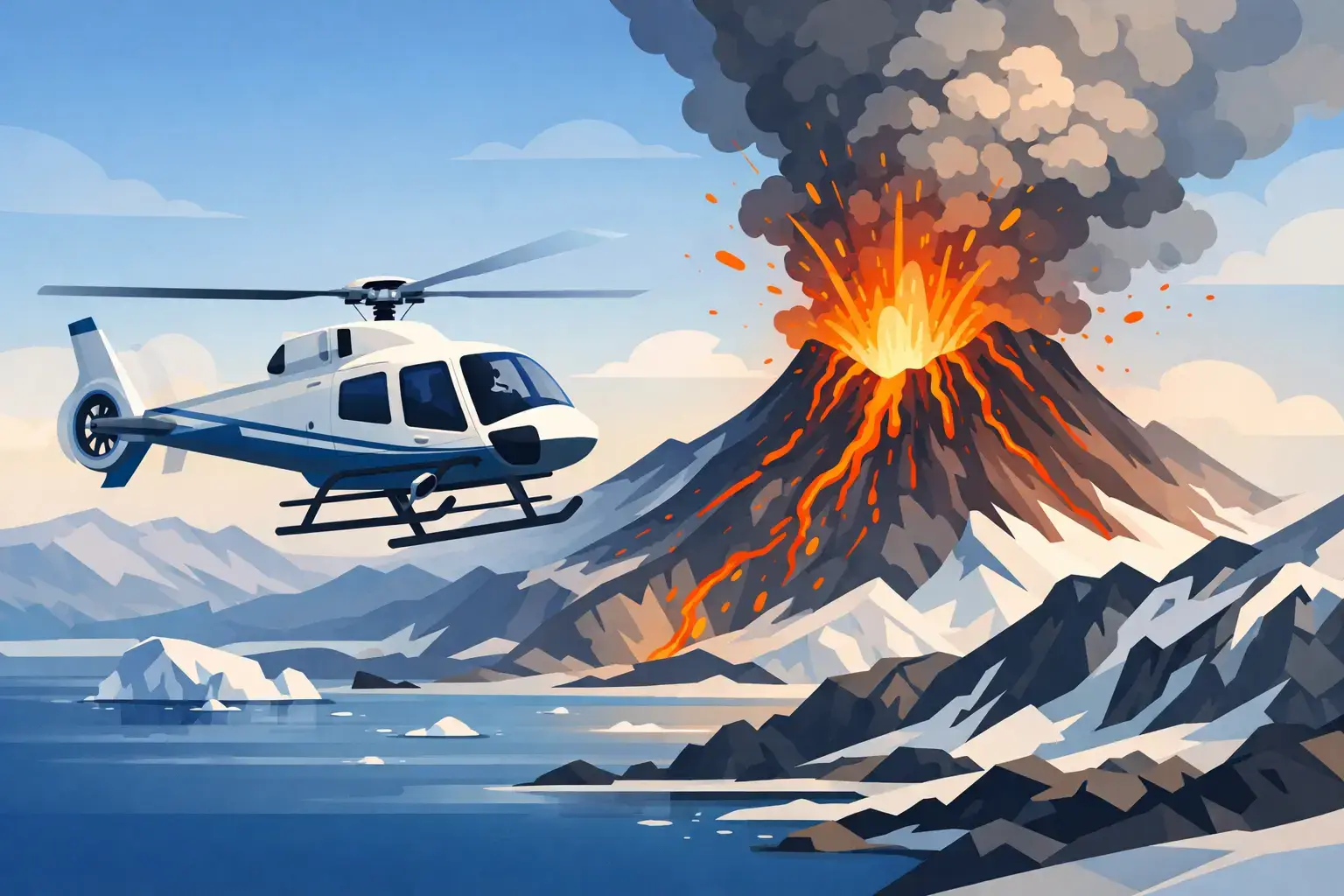
A volcano seen from the road is impressive. A volcano seen from a private helicopter is something else entirely – the shape of the crater, the black lava fields stretching outward, the steam, the scale, and the sudden understanding of how raw Iceland really is. For travelers considering a private volcano flight Iceland offers one of the rare places where that kind of access feels both dramatic and genuinely worthwhile.
This is not just a scenic shortcut. It is a way to trade hours of driving and crowded viewpoints for direct access, flexible routing, and a far more complete view of the landscape. For couples planning a once-in-a-lifetime trip, photographers chasing the right light, or private groups who want a tailored day rather than a fixed tour, a private flight changes the experience.
Why a private volcano flight in Iceland stands apart
Iceland has no shortage of headline scenery, but volcanoes are different. Glaciers and waterfalls are visually stunning from many angles. Volcanic terrain reveals itself best from above. You see how lava moved across valleys, how fissures cut through the land, and how recent eruptions reshaped areas that looked completely different only a short time ago.
That is the real advantage of booking privately. The flight can be built around what matters most to you. Some guests want the newest eruption sites on the Reykjanes Peninsula. Others want a broader route that combines volcanic areas with coastlines, geothermal zones, or glacier views. A private charter gives room for that kind of planning.
It also changes the pace. Instead of fitting into a standard departure, you can shape the day around your schedule, your group, and current conditions. In Iceland, that flexibility matters. Weather, visibility, and local volcanic access conditions can shift quickly, and the best flights are always the ones planned with both ambition and realism.
What you actually see on a private volcano flight Iceland route
The answer depends on current activity, safe flight conditions, and where you depart from, but the visual range is often much broader than guests expect. A volcano flight is rarely just about one crater.
From the air, recent eruption zones can show glowing geological contrast even when no eruption is actively underway – hardened lava fields, smoking ground, ash-dark ridgelines, and fresh geological scars that still look newly formed. In southwestern Iceland, the Reykjanes Peninsula has become especially compelling because it combines recent volcanic activity with dramatic coastal terrain and easy reach from the capital area.
Longer private charters can widen the experience further. A route may include geothermal areas, mountain ridges, remote valleys, or glacier-backed landscapes so the volcano becomes the centerpiece of a broader aerial journey. That tends to suit travelers who want the impact of volcanic scenery without limiting the entire flight to a single feature.
In the right conditions, landing adds another dimension. Not every volcano route includes a landing, and not every landing site is appropriate on every day, but stepping out into a remote Icelandic landscape is often what turns a memorable flight into a defining travel experience. The value is not only the view from the aircraft. It is the ability to pause inside the landscape itself.
Private charter vs. standard sightseeing tour
For some travelers, a scheduled sightseeing tour is enough. It gives a fixed route, a clear duration, and a simpler booking decision. But for guests looking at a private volcano flight in Iceland, the difference is not subtle.
Private charter is better for travelers who want control over timing, route emphasis, privacy, and pace. If you are celebrating something important, traveling with family, planning a proposal, or arranging a high-end day with multiple stops, the private option fits more naturally. It is also better for photographers and filmmakers who need to discuss light, angles, and timing in advance.
The trade-off is straightforward: private aviation costs more. But when compared against the time saved, the exclusivity, and the ability to combine multiple areas in a single outing, many guests find the value easy to justify. Iceland is a destination where overland travel can consume large parts of a day. A helicopter compresses distance in a way few other experiences can.
Weather, safety, and why flexibility matters
The finest volcano flights are always shaped around conditions, not wishful thinking. Icelandic weather can turn quickly, and experienced operators plan with that in mind. That is part of the appeal of flying with a local aviation team that knows the terrain, seasonal patterns, and practical limits of each route.
Visibility matters as much as precipitation. A clear-looking day on the ground may still be unsuitable for a volcano route depending on cloud cover, wind, and conditions around landing zones. That does not mean the trip is at risk of being ruined. It usually means the plan may need to be refined. Sometimes that involves adjusting departure time. Sometimes it means shifting the route to get the best possible scenery while staying fully within safe operating limits.
For premium travelers, that operational honesty is a feature, not a drawback. A serious helicopter experience in Iceland should never promise the impossible. It should promise expert judgment, good alternatives, and a route that makes sense on the day.
How to plan the right flight for your trip
The best private volcano charters start with a simple question: what do you want this flight to feel like?
If your priority is pure spectacle, a shorter focused route over active or recently active volcanic terrain may be enough. If you want a broader luxury experience, it often makes sense to combine the volcano with a mountain landing, glacier views, or a more remote scenic section that shows Iceland’s variety from above.
Timing matters too. Morning and late-day light can both be excellent, especially for photography, but the best window depends on season, route, and weather. Group size also shapes the plan. A couple may want a quiet, cinematic experience. A family might prioritize variety and comfort. A production team may need technical coordination beyond a standard sightseeing brief.
That is why custom planning is worth it. An operator like HeliAir can build the charter around where you are staying, how much time you have, and whether you want a dedicated volcano flight or a wider scenic itinerary with volcanic highlights folded in.
Who gets the most from this experience
A private volcano flight is not only for thrill-seekers. In practice, it appeals to a surprisingly broad range of travelers.
Luxury couples book it because it feels intimate and unforgettable without being staged. Families choose it because it turns long logistics into a shared experience. Private groups appreciate the exclusivity and efficiency. Photographers value the access and changing perspective. Business and production clients often need the same aircraft expertise for practical reasons, whether that means aerial filming, site access, or moving quickly across difficult terrain.
What connects all of them is the same idea: seeing Iceland properly often means seeing it from above.
Is it worth the price?
For travelers who measure experiences by how rare they are, yes. A private volcano flight Iceland experience delivers something difficult to replicate any other way – speed, perspective, and access in one flight.
It is not the right choice for every itinerary. If your trip is built around budget-conscious road travel and flexible self-drive stops, a helicopter charter may feel like a major leap. But for visitors who have limited time, want a signature day, or prefer tailored travel over fixed group touring, it can become the part of the trip that defines the rest.
The smartest way to look at it is not as a simple transport cost or a standard excursion price. It is a custom aerial experience over one of the world’s most geologically active and visually striking landscapes. That is a narrow category, and Iceland sits near the top of it.
A great private flight should leave you with more than photos. It should give you a sharper sense of the land beneath you – how it formed, how it continues to change, and why some places are best understood from the air.