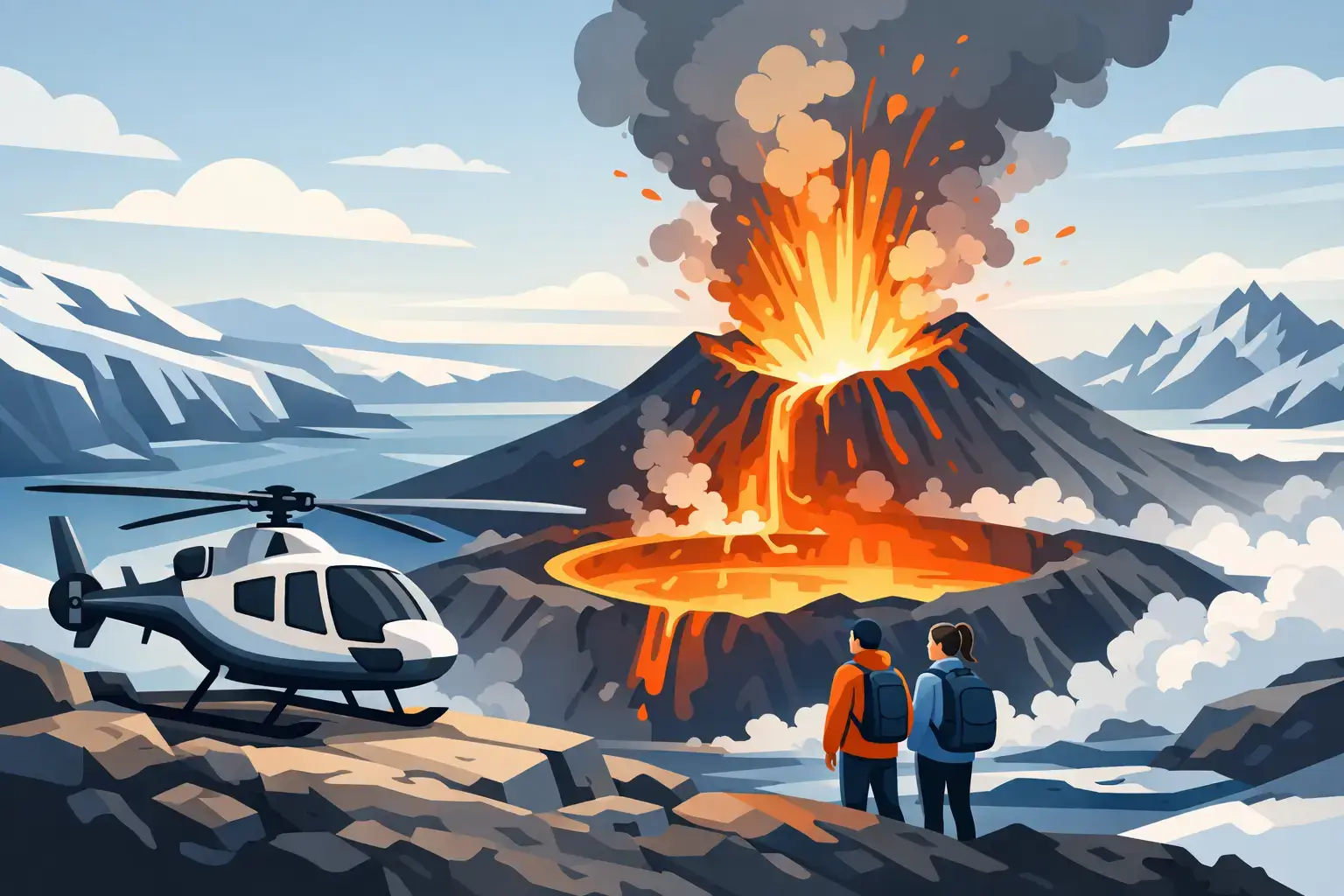
The moment the helicopter lifts out of Reykjavík, the scale of Iceland changes. Roads stop mattering, distances shrink, and a volcano landing tour Iceland experience starts to feel less like sightseeing and more like direct access to terrain most visitors only see from far away.
For travelers who want more than a scenic pass over lava fields, landing is the difference. You are not just looking at a volcanic landscape through a window. You are stepping into it, with time to take in the textures, the silence, the wind, and the raw geology that made Iceland famous in the first place.
Why a volcano landing tour Iceland experience stands out
A standard volcano tour can be impressive from the air alone. You see crater systems, lava flows, ridgelines, and black sand plains in a way no overland route can match. But when a tour includes a landing, the experience shifts from visual to physical.
That matters in Iceland, where the terrain is often the story. Fresh lava fields can look abstract from above, almost painted into the landscape. On the ground, they feel massive, irregular, and alive with detail. Older volcanic areas tell a different story, with weathered rock, moss, ash, and layers of eruption history that become far more vivid when you are standing in the middle of them.
For many guests, this is also about time. Reaching dramatic volcanic areas by vehicle and foot can mean a full day of logistics, changing conditions, and limited flexibility. By helicopter, you trade the long approach for access. You spend less time getting there and more time actually experiencing the place.
What the flight is really like
Most premium volcano tours begin with a short safety briefing and a weather check. That may sound procedural, but in Iceland it is part of good planning. Conditions can change fast, and the best operators build the route around what is safe, visible, and worthwhile that day.
Once airborne, the first surprise for many visitors is how quickly the urban edge disappears. Within minutes, the landscape opens into lava fields, coastlines, mountain ridges, and geothermal zones. Depending on route and conditions, a volcano flight may combine several of these elements in a single itinerary, which is part of what makes the helicopter format so compelling.
The landing itself is usually the emotional high point. There is a distinct shift when the rotors slow and the aircraft settles into a place that feels remote, exposed, and unreachable by ordinary travel. You step out into air that feels cleaner, colder, and sharper. Even guests who have spent days touring Iceland often say this is the first time the country feels truly vast.
That does not mean every landing is the same. Some sites feel stark and lunar, shaped by black rock and recent geological activity. Others are broader and more cinematic, with views extending across glaciers, valleys, or the coastline. The route, the season, and the day’s conditions all shape the experience.
Who this kind of tour suits best
A volcano landing tour is not only for extreme adventure travelers. In practice, it appeals to a wider group of guests who want a high-value experience and would rather spend their time in the landscape than in transit.
It works especially well for couples celebrating something significant, families looking for a once-in-a-lifetime Iceland day, photographers who want strong vantage points, and private groups with limited time. It also suits travelers who like comfort but do not want a passive luxury experience. Helicopter access is premium, but the payoff is active and memorable.
There are trade-offs, of course. If someone wants a long technical hike, this is a different kind of day. A helicopter volcano tour is about access, perspective, and curated time in exceptional places. It is less about endurance and more about getting close to Iceland’s most dramatic terrain without spending hours reaching it.
When to book a volcano landing tour in Iceland
There is no single perfect month because volcanic landscapes look different across the year. Summer brings longer daylight, easier visibility, and broader operational flexibility. The colors are more varied, and surrounding highland terrain often adds contrast to the black lava and craters.
Winter can be extraordinary for a different reason. Snow and low sun reshape the volcanic landscape and create sharper contrast from the air. But winter also brings more weather variability, and that can affect routing, timing, and landing options.
Shoulder seasons often strike a useful balance. You may get strong light, fewer crowds in the wider travel market, and dramatic conditions without the peak summer rush. The right answer depends on whether your priority is stable touring conditions, seasonal contrast, photography, or simply fitting the flight into a broader Iceland itinerary.
If you are planning around one specific helicopter experience, it makes sense to keep some flexibility in your schedule. That gives the operator room to choose the best window rather than forcing a flight into marginal conditions.
Weather, safety, and why flexibility matters
In Iceland, weather is not a footnote. It shapes aviation every day. That is not a drawback so much as a reality of operating in a serious landscape.
A well-run volcano landing tour puts safety first without making the experience feel rigid. Routes may be adjusted based on visibility, wind, cloud base, and landing conditions. In practical terms, that means the exact volcanic site or sequence of sights can change. For guests who understand Iceland, that is usually a good sign. You want local pilots making real-time decisions, not following a fixed script when conditions say otherwise.
This is also why premium helicopter touring has such strong value when handled properly. It combines exclusivity with judgment. The aircraft gives access, but the operator’s local knowledge determines whether that access becomes exceptional.
Private tour or shared experience?
It depends on what you want from the day. A shared flight can be a strong option for travelers who mainly want the experience of flying over and landing in volcanic terrain at a more accessible entry point. You still get the drama of the landscape and the core thrill of helicopter access.
A private tour is where the experience becomes more tailored. That may mean shaping the route around photography, pairing the volcano landing with a glacier or waterfall, adjusting departure timing for better light, or simply creating a quieter, more personal atmosphere. For anniversaries, proposals, family travel, and high-end Iceland itineraries, private flights often make the most sense.
For guests already investing in premium accommodation, private guides, or a short Iceland stay, the helicopter often becomes the most efficient way to reach places that would otherwise consume an entire day.
How to prepare without overthinking it
Dress for exposure, not for the city. Even if your day starts in calm conditions, landing sites can be windy and colder than expected. Wear sturdy shoes, layered clothing, and sunglasses if conditions are bright.
Bring a camera, but do not spend the whole landing behind it. Volcanic terrain is one of those places that can become strangely abstract in photos if you never stop to absorb the scale. A few great images matter more than hundreds of rushed ones.
Most of all, approach the tour with the right expectation. This is not a theme-park version of a volcano. It is Iceland on its own terms – weather-shaped, geologically dramatic, and variable from one day to the next. That is exactly what gives it value.
The real value of landing, not just flying over
Aerial sightseeing in Iceland is already special. A landing makes it personal. It creates a pause in the middle of a landscape that usually feels out of reach, and that pause is often what guests remember most.
For travelers considering a volcano landing tour Iceland experience, the question is not simply whether the view is worth it. The view almost certainly is. The better question is whether you want to spend part of your Iceland trip seeing the country from a distance, or standing in a place that very few visitors reach at all.
That is the appeal of flying with a local operator such as HeliAir. The experience is not built around checking off a landmark. It is built around getting you into the right place, at the right time, with the kind of access that changes how Iceland feels. If you want one part of your trip to stay sharp long after the rest begins to blur together, this is usually the one.