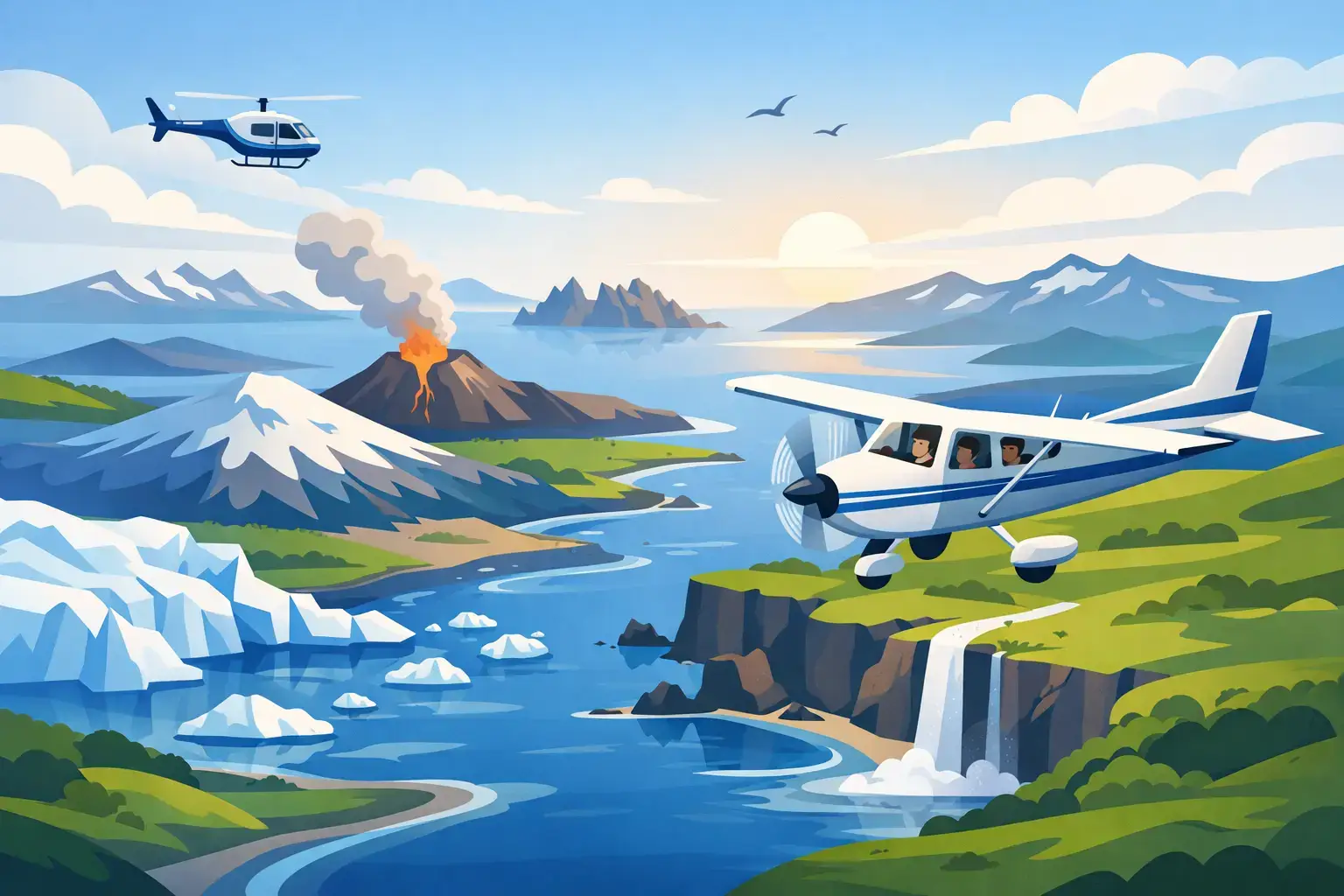
The difference starts the moment you leave the ground. Roads in Iceland are part of the adventure, but they also impose distance, weather delays, and a fixed perspective. An Iceland aerial sightseeing guide matters because the country was shaped on a scale that often makes the best terrain difficult to grasp from ground level. From the air, you see how lava fields run into glacier tongues, how river systems cut through black sand, and how remote highland basins sit far beyond the reach of an ordinary day trip.
For travelers planning one standout experience, aerial sightseeing is less about checking off landmarks and more about choosing what kind of Iceland you want to experience. Some flights are about iconic scenery near Reykjavík. Others are built around landings on mountain ridges, glacier edges, or volcanic terrain that would otherwise take a long overland journey to access. The right choice depends on your time, budget, weather flexibility, and whether you want a classic scenic tour or a fully tailored charter.
How to use this Iceland aerial sightseeing guide
The first decision is simple: do you want a scheduled sightseeing experience or a custom helicopter day built around your priorities? A shorter tour works well if you want a premium highlight without giving up an entire day. It gives you strong scenery, efficient logistics, and a clear route. A custom charter is better when the destination matters as much as the flight itself, especially for photographers, private groups, proposals, family celebrations, or travelers trying to reach several remote sites in one day.
Departure point also shapes the experience. Flights from Reykjavík are ideal for visitors already based in the capital or arriving on a tight itinerary. Northern departures, including routes from Ólafsfjörður, open a different side of Iceland, with dramatic mountain coastlines, snow conditions in season, and access that suits heli-skiing support or bespoke exploration away from the busiest visitor corridors.
What many travelers underestimate is how much time a helicopter saves. A place that could take half a day by vehicle, assuming roads are open and conditions cooperate, may become a practical stop within a much broader aerial route. That efficiency is a major part of the value, especially for luxury travelers trying to experience Iceland deeply in limited time.
What you can actually see from the air
Iceland rewards altitude. Waterfalls that look impressive from a viewing platform become part of larger canyon systems. Glaciers reveal their fractured surfaces and long ice flows. Volcanic zones stop looking like isolated attractions and start to read as active landscapes, with craters, fissures, lava fields, and ash-colored ridges connected across miles.
For many guests, the strongest routes combine contrast. A single flight might include green coastal lowlands, dark lava terrain, braided glacial rivers, and snow-covered heights. That variety is why aerial sightseeing feels so different here compared with a standard scenic flight elsewhere. Iceland changes fast, and from above the transitions are immediate.
Landings can elevate the experience further, but they are not always the main point. Some travelers want uninterrupted scenic time in the air. Others want the chance to step out in a place that feels otherwise unreachable. A mountain landing for photos, a glacier-edge stop, or a remote highland touch-down adds privacy and scale in a way that ground touring rarely matches.
Choosing the right flight length
Shorter scenic flights are often the smartest fit for first-time visitors. You get a strong sense of Iceland’s topography, you avoid a major time commitment, and you still have room in the day for other plans. This works especially well for couples on a premium city-based itinerary, cruise guests with limited time, or families wanting one exceptional activity without a full-day logistics chain.
Mid-length flights tend to offer the best balance. They allow enough time to move beyond the immediate outskirts of a departure base and into more dramatic territory. They also create room for route flexibility if weather conditions shift. For many guests, this is the sweet spot between price and access.
Longer scenic flights and full-day helicopter experiences are where customization really shows its value. If your goal is to combine several major landscapes in one outing, add landings, or build the day around photography and privacy, extra flight time matters. The trade-off is obvious: a longer charter costs more, and weather planning becomes even more important. But for travelers who want a once-in-a-lifetime experience rather than a standard excursion, this is often where Iceland feels most exclusive.
Weather, season, and the reality of flying in Iceland
Any honest Iceland aerial sightseeing guide has to say this plainly: weather decides more than marketing does. Conditions can change quickly, and good operators plan around that reality rather than pretending it is a minor detail. Cloud ceiling, wind, visibility, and landing-site conditions all affect what is possible on the day.
That does not mean helicopter sightseeing is unreliable. It means flexibility matters. If aerial touring is high on your priority list, do not place it in the final unmovable hour of your trip. Build some margin into your schedule when possible. Morning conditions may differ from afternoon conditions, and one region may fly better than another.
Season changes the look of the country, but there is no single best time for everyone. Summer offers long daylight hours and broad access to highland terrain. Shoulder seasons can deliver dramatic light, fewer visitors, and strong visual contrast. Winter brings snow coverage, low-angle light, and a sharper, more alpine feel, especially in the north. The trade-off is that winter conditions can be more restrictive, and your route may need to adapt.
For photographers, this matters even more than for general sightseers. Snow can simplify the landscape in beautiful ways, while summer reveals geological texture and color. If your priority is image-making rather than general sightseeing, the ideal season depends on what you want your Iceland to look like.
Scenic tour or private charter?
A scenic tour is the right option when you want a polished route, clear timing, and a straightforward decision. It is efficient, premium, and easy to fit into a wider Iceland itinerary. For many travelers, that is exactly the point.
A private charter makes sense when the day needs to revolve around you rather than the route. That could mean a custom proposal landing, a family celebration, a volcano-focused flight, a transfer folded into sightseeing, or a plan that reaches several remote highlights without returning to the road in between. It is also the better choice for travelers who value privacy, have a specific destination in mind, or want to combine scenic flying with practical transport.
This is where an operator like HeliAir stands apart. The value is not just in offering set tours, but in being able to shape a helicopter journey around where you actually want to go, whether that is a glacier, a waterfall, a remote highland site, or an airport transfer that becomes part of the experience rather than dead time.
Who gets the most out of aerial sightseeing in Iceland
This experience is best for travelers who value access and perspective more than volume. If you prefer to cover ten low-cost stops by car, a helicopter is not the logical fit. If you want one extraordinary window into Iceland’s scale, and you want to reach places that would otherwise consume most of a day, it makes immediate sense.
It is especially strong for couples celebrating something meaningful, private groups, families with limited time, photographers, and luxury travelers who want Iceland to feel both cinematic and personal. It also works well for people who are comfortable paying more for less friction. Avoiding long drives, changing road conditions, and crowded viewing areas has real value when the trip itself is meant to feel exceptional.
Commercial and specialist users come to aerial operators for a different reason. For them, sightseeing may be secondary to logistics. Aerial filming, mountain access, heli-skiing support, point-to-point flights, and sling work all require local knowledge and aviation capability that go well beyond standard tourism. The best operators can handle both worlds without making either feel improvised.
What to ask before you book
The most useful questions are practical ones. Ask whether the route is fixed or adaptable, whether a landing is included or weather-dependent, how many passengers the aircraft can accommodate, and what kind of flexibility exists if conditions change. If you are booking a private experience, ask what can realistically fit into your time window rather than assuming every wish list can be combined in one flight.
It is also worth being clear about your priorities. If seeing a volcano matters more than photographing a waterfall, say so. If privacy matters more than total flight duration, say that too. Good aerial planning starts with trade-offs, not assumptions.
The best Iceland flights are rarely the ones that try to include everything. They are the ones built around a clear idea of what will make the day feel unforgettable for you. Choose the perspective first, then let the route follow.