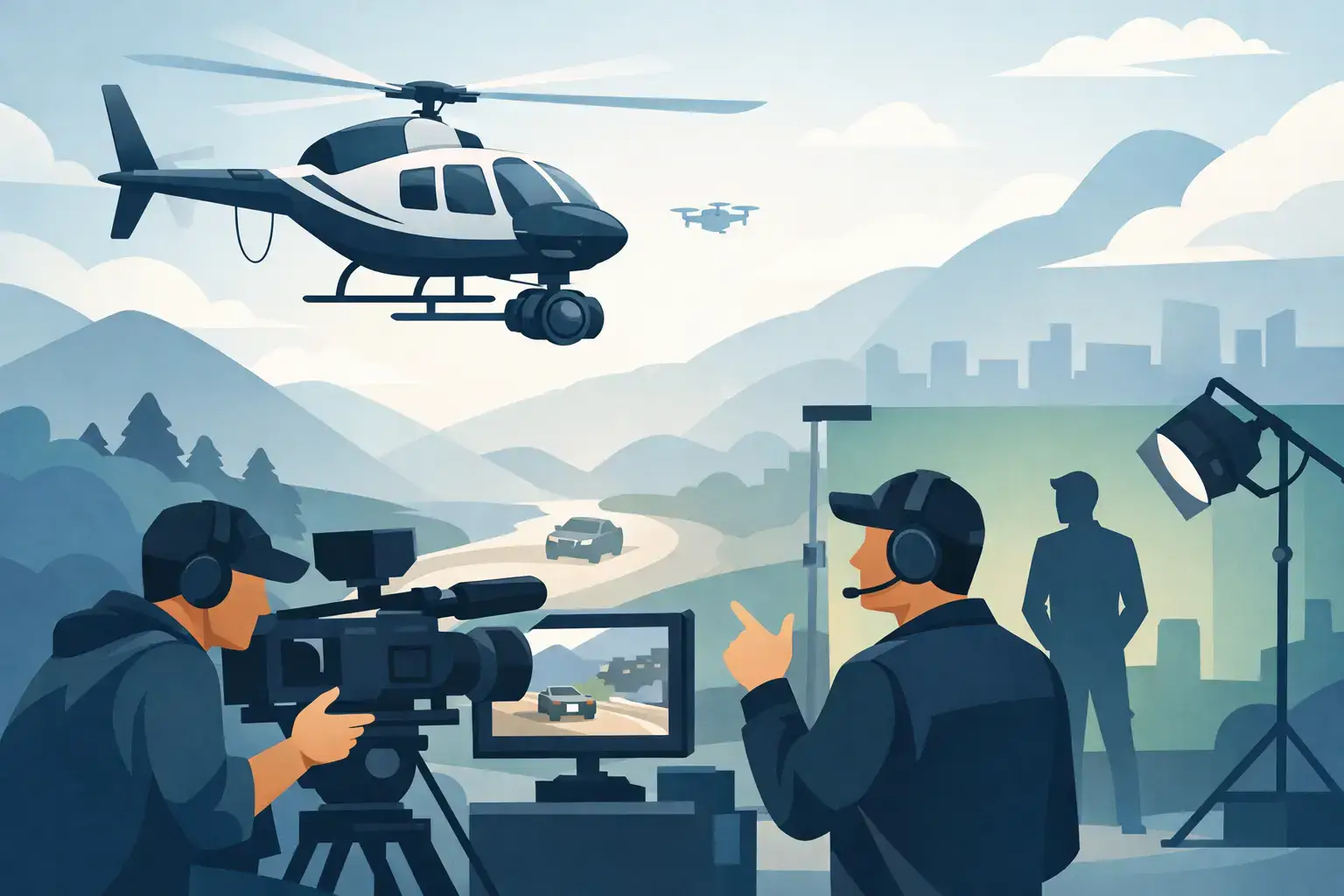
A sunrise window over a glacier does not wait for a slow road transfer, and a remote waterfall does not get easier to reach because the schedule is tight. That is where helicopter support for film production changes the equation. In Iceland, it can turn a difficult location into a workable shoot day, giving crews direct access to terrain that would otherwise take hours to approach – if it is reachable at all.
For producers, directors, location managers, and DPs, the value is not just the shot from the air. It is time, control, and range. A helicopter can move key crew, talent, and equipment into position quickly, help capture aerial footage with a clear operational plan, and support multi-location days that would be unrealistic by road. In a country defined by glaciers, black sand, volcanoes, highlands, and deep-cut canyons, that flexibility matters.
What helicopter support for film production actually covers
Film crews often hear the phrase and think only of aerial cinematography. That is part of it, but the scope is wider. Helicopter support for film production can include transporting crew to remote sets, moving camera teams between locations, scouting from the air, landing on approved sites near natural landmarks, and supporting specialist operations where access is limited by terrain or time.
The right setup depends on the production. A commercial shoot may need a short flight to capture a dramatic opening sequence above a volcanic landscape. A documentary team may need repeated access to isolated areas over several days. A stills campaign may want air-to-ground flexibility so the photographer can shoot from the helicopter, then land nearby for ground coverage. Each of those jobs asks for a slightly different operating plan, and that plan should be built around the creative brief, the weather, and the location realities.
Why Iceland is different
Iceland offers scale that reads beautifully on camera, but it also asks crews to plan carefully. Distances can look manageable on a map and still consume most of a day on the ground. Roads into highland areas are seasonal. Weather shifts can affect visibility, landing options, and timing. Even popular landmarks can involve a longer approach than expected once a production starts moving people, kit, and vehicles.
A helicopter does not remove those variables. It helps crews work with them more intelligently. Instead of losing hours to transfers, productions can use flight time to scout angles, assess light on approach, and position teams where they need to be when conditions line up. That is especially useful when the schedule is built around narrow daylight windows, changing cloud cover, or a location that looks entirely different from one hour to the next.
There is also the matter of perspective. Iceland’s landscapes are not only impressive because they are large. They have shape, texture, and contrast that reveal themselves best from above. Braided rivers, ice formations, lava fields, crater systems, cliff lines, and isolated waterfalls often become more cinematic when the camera can move through the terrain rather than simply observe it from ground level.
Planning helicopter support for film production
The best flight days start well before takeoff. A production should approach helicopter planning as both a creative and operational exercise. The creative team needs clarity on what matters most – wide establishing shots, repeated passes, remote landings, cast movement, or a combination. The aviation side needs to know where the shoot is happening, what equipment is involved, how many people are flying, and how flexible the schedule can be if conditions change.
This is where experience in Iceland matters. A local operator can help pressure-test a plan before the day arrives. Some locations look ideal in a deck and turn out to be poor matches for landing, timing, or safe camera operation. Others may offer a better visual result than the original concept because they combine access, light, and flying conditions more effectively.
A useful production conversation usually covers a few core points. First, what is essential footage and what is optional. Second, whether the helicopter is needed purely as a camera platform or also as transport. Third, whether the day requires one fixed route or the flexibility to adapt once conditions are visible in real time. In Iceland, that last point is often the difference between a frustrating day and a productive one.
Aerial filming versus access support
Some productions need the helicopter in the frame strategy. Others need it mostly for logistics. Those are not the same job.
If the goal is aerial filming, the emphasis is on flight path, speed, altitude, door configuration, communication, and how the camera team will work safely and efficiently in the aircraft. If the goal is access support, the emphasis shifts toward moving people and select gear to locations that are otherwise slow or impractical to reach.
Many projects need both. A crew may begin with aerial passes over a glacier tongue, then land nearby to continue on the ground with a smaller unit. That kind of hybrid use can be highly efficient, but only if the day is built realistically. Packing too much into a single charter can create pressure on timing and reduce the chance of getting the best results at each stage.
The trade-offs producers should expect
Helicopters save time, but they do not make every production simpler. Weight limits, weather calls, and operational safety are part of the process. A lean team with a focused shot list can move very efficiently. A large production with extensive equipment may need multiple lifts, tighter prioritization, or a mixed transport model using both ground and air support.
Budget is another practical factor. Helicopter support delivers real production value, especially in a place like Iceland, but it works best when it is tied to clear outcomes. If the aircraft allows a crew to capture three remote locations in one day, protect a narrow weather window, or secure an aerial sequence that defines the final film, the investment is easier to justify. If the plan is vague, flight time can disappear quickly without enough usable material to show for it.
There is also a creative trade-off worth stating plainly. Not every landscape needs an airborne shot. Some scenes are stronger from the ground. The most effective productions use helicopters with intention, not as a default. They choose moments where motion, scale, and access genuinely improve the story.
Working with weather instead of fighting it
In Iceland, weather is not a side note to production planning. It is one of the main drivers of what is possible. Wind, visibility, precipitation, and cloud layers can all affect a flight plan. That does not mean a shoot is always at risk. It means the strongest productions build in flexibility and work with an operator who can assess conditions honestly.
Sometimes the right call is a time shift rather than a cancellation. Sometimes a nearby alternate location delivers a better result than waiting for a first-choice site to clear. Sometimes the weather itself becomes part of the visual character, adding atmosphere and movement that a blue-sky plan would not have offered. The key is not pretending Iceland will behave predictably. It is building a production plan that can still succeed when it does not.
Choosing the right aviation partner
For film work, aircraft availability is only one piece of the puzzle. Productions need an operator that understands both flight operations and the pace of location shooting. Clear communication matters. So does local knowledge, especially when a schedule includes remote areas, shifting conditions, or a brief that may evolve during planning.
An experienced Iceland operator should be able to discuss more than charter hours. They should be able to talk through landing access, routing logic, likely weather considerations, realistic timing between sites, and how to shape a flight around the needs of the crew. HeliAir works with exactly this mix of premium travel, technical charter flying, and aerial filming support, which is why bespoke planning is usually the right place to start.
For producers coming from outside Iceland, that planning support is often as valuable as the aircraft itself. It shortens the gap between concept and execution. It also helps crews avoid a common mistake: assuming that because Iceland feels wild and open, it can be approached casually. The landscapes are generous on camera, but they reward precision.
The best helicopter-supported shoots tend to feel surprisingly calm once they are underway. Everyone knows the plan, the shot priorities are clear, and the route has been built around what the day can realistically deliver. That is when a helicopter stops being a luxury line item and starts functioning as what it really is – a serious production tool for getting exceptional work done in exceptional terrain.
If your next project needs speed, reach, and a sharper way to work in Iceland’s most cinematic locations, start with the shots that truly matter and build the flight around them.