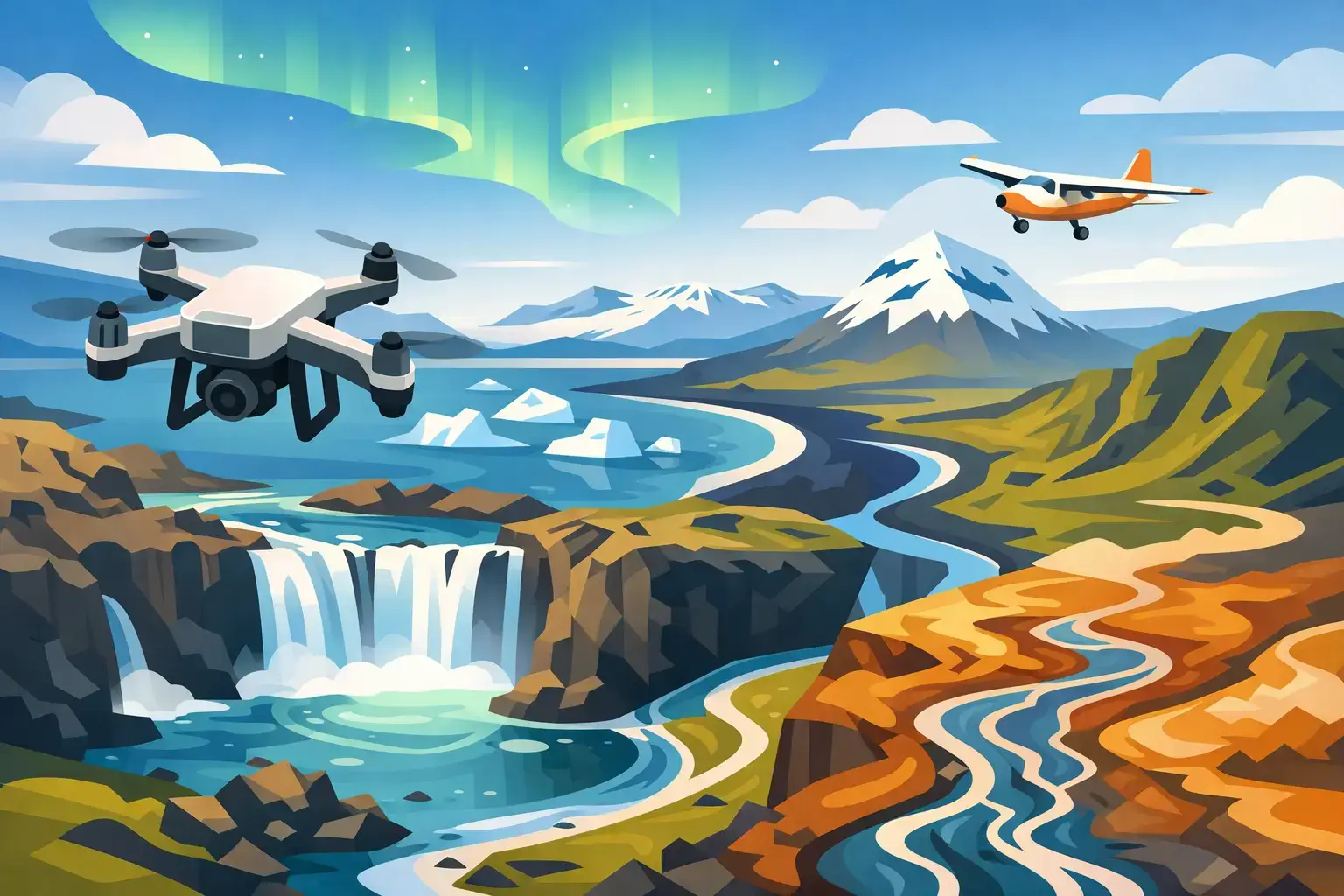
Some landscapes only make sense once you leave the road behind. In Iceland, that is especially true. The best aerial photography locations are often the places that feel fragmented from the ground – braided rivers, volcanic fissures, ice caps, crater rims, and waterfall systems that reveal their full shape only from above.
For photographers planning a premium trip, the real question is not just where Iceland looks dramatic. It is which places translate into strong aerial compositions, which routes offer the most variety in changing light, and which locations justify the flexibility of a helicopter rather than a fixed sightseeing path. Some sites are iconic for good reason. Others are stronger from the air because they are difficult, slow, or simply impossible to appreciate properly by car.
What makes the best aerial photography locations
Great aerial imagery is rarely about a single landmark sitting in the middle of the frame. It is about structure. Iceland gives you that in unusual abundance – contrasting textures, abrupt elevation changes, glacial movement, volcanic damage, and river systems that look almost abstract from altitude.
The best aerial photography locations tend to offer one or more of three things. First, they have graphic shape, like crater rings, winding canyons, or black sand deltas. Second, they have strong contrast, such as white ice against volcanic ash or green moss against fresh lava. Third, they have scale, where tiny roads, rivers, or people help define the size of the terrain. The strongest flights usually combine all three.
Timing matters just as much as geography. Summer gives you long shooting windows and access to the highlands, but the flatter midday light can soften texture. Winter can be exceptional for contrast and low-angle light, although conditions are less predictable and some interiors become harder to access. That trade-off is part of planning well.
12 best aerial photography locations worth prioritizing
1. Landmannalaugar and the Fjallabak highlands
Landmannalaugar is one of Iceland’s richest aerial subjects because it does not rely on one feature. The area layers rhyolite mountains, geothermal scars, snow patches, lava fields, and braided tracks into a frame that feels almost unreal. From above, the color variation is the story.
This is one of the strongest choices for photographers who want a portfolio with depth rather than a single hero shot. It also rewards custom routing because the surrounding Fjallabak region can shift quickly from soft mineral color to dark lava texture within minutes.
2. Háifoss and the Þjórsárdalur valley
Háifoss has presence from the ground, but from the air you understand its full setting. The waterfall drops into a deep canyon system that opens into a wider valley shaped by old volcanic events. That combination of vertical drop and horizontal landscape makes it especially photogenic.
This is also a good example of a location where a helicopter adds efficiency, not just style. Reaching it overland takes time, and aerial access lets you work the falls, canyon, and surrounding highland terrain in a single session.
3. Eyjafjallajökull and its glacial-volcanic edge
Few places show Iceland’s geology more clearly than Eyjafjallajökull. From the air, the relationship between glacier, ash-streaked slopes, and surrounding lowlands becomes much more legible. The area often produces dramatic tonal separation, especially when light catches ice fields while darker volcanic ground stays muted.
For photographers, this location works best when conditions allow varied passes rather than one quick overflight. The glacier itself is compelling, but the transitional zones around it often produce the most interesting frames.
4. Active or recent volcanic sites on the Reykjanes Peninsula
Volcanic areas on Reykjanes can be extraordinary aerial subjects, particularly when fresh lava fields, vents, smoke, and hardened flow patterns remain visible. These sites can change from season to season, which is exactly why they attract serious photographers.
The obvious benefit is access to current geological drama. The less obvious one is texture. Even after activity subsides, cooling lava creates intricate surface patterns that read beautifully from above. The trade-off is that routing depends heavily on safety restrictions, weather, and current activity.
5. Þórsmörk
Þórsmörk is one of the best aerial photography locations for photographers who want complexity inside one compact region. Glacial rivers carve through black sand plains, green ridges rise sharply, and nearby ice caps shape the wider background. It is a place of constant visual tension between softness and force.
From a photography standpoint, Þórsmörk is particularly strong in shifting light because the landscape has enough texture to stay interesting even when conditions are not perfect. It also pairs well with nearby glacier and volcano routes.
6. Mýrdalsjökull and Katla territory
Mýrdalsjökull offers broad ice formations with a darker, moodier character than some of Iceland’s other glacier systems. The volcanic influence beneath the ice adds drama, and the surrounding terrain often creates a stark transition from frozen surfaces to black lowlands.
This area suits photographers drawn to minimalism and tonal contrast. In clear conditions, the compositions can feel almost monochrome, which is part of the appeal.
7. The black sand coast near Vík
Coastal aerial work in Iceland can be as strong as highland imagery, and the black sand stretch near Vík proves it. Sea stacks, surf lines, basalt formations, and long dark beaches create sharp, cinematic compositions from altitude.
This location is less about remote access and more about perspective. From the ground, the coast feels dramatic. From above, it becomes graphic. Tide, swell, and weather all affect the look, so flexibility matters.
8. Jökulsárlón and the glacial outwash plains
Jökulsárlón is famous, but its aerial value goes far beyond the lagoon itself. The surrounding glacial rivers, sediment patterns, and ice movement create a broad field of photographic opportunities. Some frames are all detail. Others are about scale and flow.
This is one of those locations where a photographer can move from elegant blue-white ice imagery to more abstract landscape work in the same flight. If your priority is variety, it is hard to beat.
9. Vatnajökull outlet glaciers
The larger Vatnajökull system contains numerous outlet glaciers that photograph beautifully from the air. Crevasses, ash lines, melt channels, and fractured ice surfaces produce strong natural geometry. Different outlets also have distinct personalities, which makes custom planning worthwhile.
Aerial photography here benefits from a patient approach. The most effective images often come from working angles carefully rather than chasing sheer altitude.
10. The Westman Islands
The Westman Islands bring together cliffs, ocean exposure, volcanic terrain, and compact coastal settlements in a way that feels very different from mainland Iceland. From above, the islands have a sculptural quality, especially when light catches the cliff edges and offshore sea stacks.
This is an excellent choice for photographers who want a mix of nature and human scale. The volcanic history is visible, but so is the way people have adapted to the landscape.
11. Kerlingarfjöll
Kerlingarfjöll is often overlooked by first-time visitors, which is part of its appeal. The area is marked by geothermal valleys, rust-colored mountains, snow remnants, and remote highland isolation. From the air, the colors and erosion patterns create painterly images.
It is not the easiest location to describe because the appeal is less iconic and more atmospheric. For the right photographer, that is exactly the point.
12. The Snæfellsnes Peninsula
If you want range in one region, Snæfellsnes is a smart choice. Volcanic peaks, coastal cliffs, lava fields, glacier-capped views, and fishing villages all fit into a relatively contained area. It can deliver broad scenic work or tighter compositions depending on weather and route.
This peninsula is especially useful for travelers with limited time who still want multiple landscape types in a single aerial session.
How to choose the right location for your shoot
The best aerial photography locations are not always the most famous ones. They are the ones that match your visual style, schedule, and tolerance for changing conditions. If you want bold color and geological variety, the highlands often outperform the coast. If you prefer clean contrast and recognizable landmarks, glacier and black sand routes may be the stronger fit.
Weather also changes the equation. A lightly overcast day can be disappointing for some coastal scenes but excellent for glaciers, where diffused light preserves detail in bright ice. Likewise, low sun can transform canyon and waterfall work but may create harder shadow management in steeper terrain. Good planning starts with knowing what kind of portfolio you want to come home with.
For travelers building a custom helicopter experience, this is where local flight knowledge matters. In Iceland, the difference between a good route and a great one is often small on a map and huge in the air. Operators with experience in aerial tourism and photography logistics can adjust for visibility, season, light direction, and how a landscape actually reads from altitude, which is exactly where a company like HeliAir adds value.
The smartest approach is to think in combinations rather than single stops. A glacier paired with volcanic terrain, or a waterfall route combined with highland textures, usually produces a stronger body of work than repeating one visual note. Iceland rewards photographers who stay flexible and ambitious at the same time.
If you are planning to photograph Iceland from above, choose places that do more than look famous from a brochure. Choose landscapes that change shape as you circle them, reveal new lines with each pass, and still feel bigger than the frame when you land.