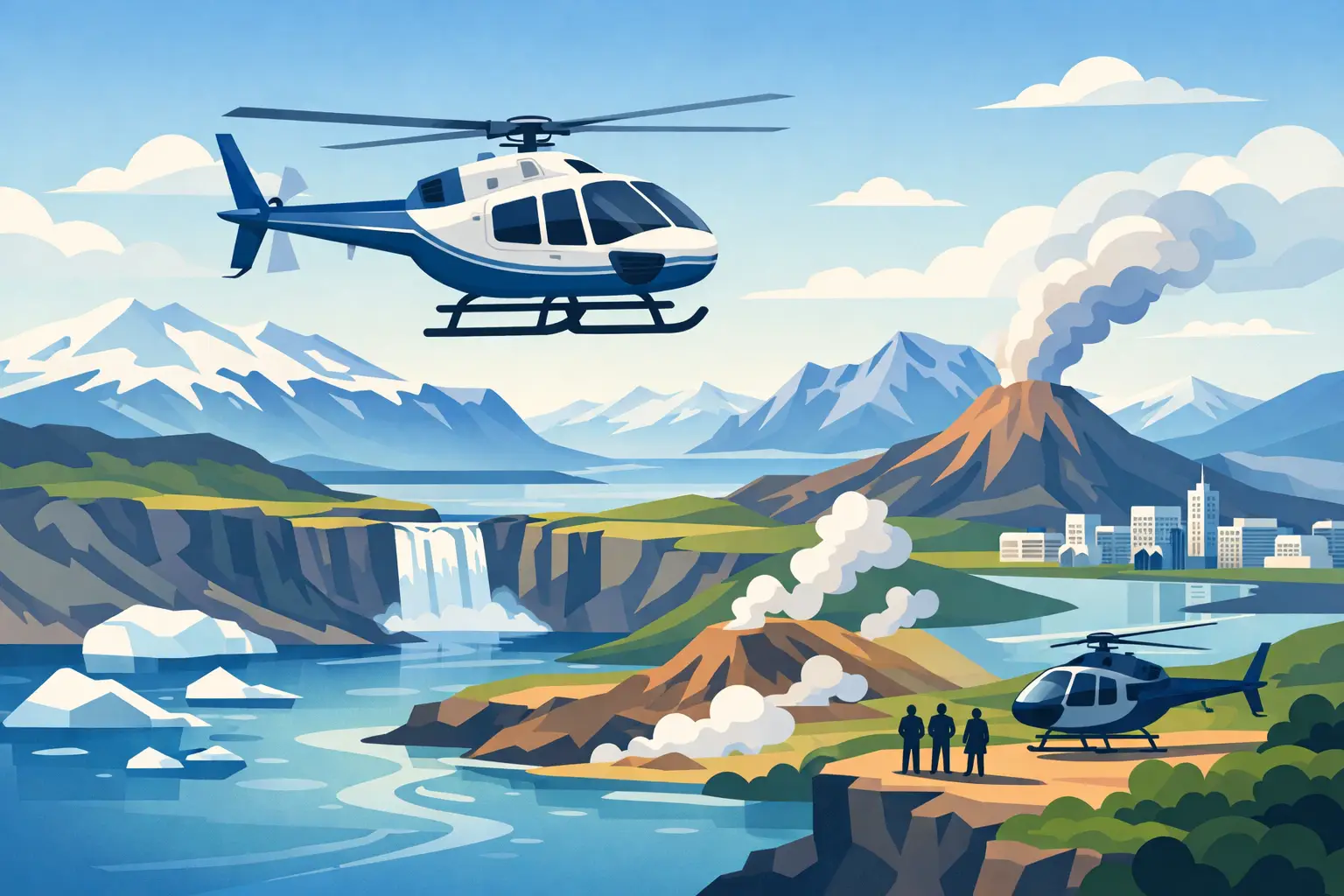
A road trip from Reykjavík to a remote glacier, highland waterfall, or active volcanic landscape can take most of a day. By helicopter, the journey becomes part of the experience, with views that reveal the scale of Iceland’s black-sand coasts, lava fields, ice caps, and deep valleys. This guide to helicopter charter uses explains where private aviation adds the most value, whether your priority is an extraordinary day out, efficient travel, or specialist aerial support.
A charter is not simply a sightseeing flight with a private cabin. It is a flight arranged around your itinerary, group, timing, and intended destination, subject to weather, landing conditions, aircraft capability, and operational approvals. That flexibility makes helicopter charter especially well suited to Iceland, where dramatic places are often separated by long drives and changeable conditions.
Helicopter Charter Uses for Iceland Travel
Private scenic flights with remote landings
The most memorable charter use is often a tailored scenic journey with landings in places that are difficult or time-consuming to reach by road. A private helicopter can turn a single afternoon into a glacier landing, a pass over volcanic terrain, and time beside a highland waterfall, all without spending hours between destinations in a vehicle.
For couples, families, and private groups, the advantage is control. You can choose the balance between flight time and time on the ground, build the route around specific landscapes, and move at a more personal pace than a scheduled tour allows. A photographer may want the low afternoon light over a glacier tongue. A family may prefer a shorter flight with one remarkable landing. A group celebrating a milestone may want a full-day route that pairs several regions of Iceland in one experience.
The trade-off is that Icelandic weather remains in charge. Clouds, wind, visibility, and conditions at a proposed landing site can require a route adjustment, a different landing, a delay, or cancellation. The best charter plans have a clear wish list, but leave room for the pilot and operations team to recommend the safest and most rewarding option on the day.
Airport and point-to-point transfers
Helicopters are also a practical answer to limited time. A private transfer from Keflavík International Airport or Reykjavík Domestic Airport can replace a long ground journey and establish an entirely different beginning to an Iceland itinerary. Rather than spending valuable daylight in transit, travelers can arrive close to a remote lodge, connect with an onward excursion, or continue to a destination that would otherwise require several hours of driving.
Point-to-point charter works particularly well for guests combining Reykjavik with the south coast, private highland stays, northern adventures, or locations with limited road access. It can also simplify logistics for groups with a fixed schedule, including a cruise call, an event, or an international departure later the same day.
This option is best judged by the value of time rather than distance alone. For a short route with easy road access, a vehicle may be the sensible choice. For a journey that involves a full day of driving, tight connections, or a destination far from Iceland’s main roads, a helicopter can create meaningful time for the experiences that brought you here.
A Guide to Helicopter Charter Uses Beyond Sightseeing
Aerial filming and photography
Iceland looks different from the air. Rivers braid through black sands, waterfalls cut across green cliffs, and glaciers form blue-white patterns that cannot be understood from a roadside viewpoint. For production teams, commercial projects, documentary crews, and professional photographers, a helicopter provides both perspective and access.
Aerial filming charters need more preparation than a leisure flight. The required shots, camera equipment, passenger positions, intended altitude, timing, and potential ground locations all shape the flight plan. Light conditions matter, but so do safety procedures for working around aircraft and managing gear in exposed terrain.
An experienced operator can help assess what is realistic within the weather window and flight time available. A flexible shot list is usually more productive than a rigid one. Iceland can offer perfect light in one direction while low cloud limits another, so production crews benefit from planning a primary route and alternate locations in advance.
Heli-skiing access
For experienced skiers, helicopter access opens terrain that cannot be reached during an ordinary ski day. It allows teams to travel efficiently to selected mountain areas and make the most of suitable snow and weather windows. The flight itself is only one part of the operation. Mountain knowledge, snow conditions, group ability, equipment, guides, and safety planning are equally central.
Heli-skiing is highly condition-dependent, and no responsible operation promises a particular run or peak before assessing the day. Wind, avalanche risk, visibility, and snow stability determine where it is appropriate to fly and ski. Guests should approach the experience with strong skiing ability, realistic expectations, and a willingness to follow professional guidance throughout the day.
Sling work and technical operations
Not every helicopter charter is designed around guests. Utility work can support projects in places where roads are absent, terrain is difficult, or heavy equipment cannot be moved efficiently by ground. Sling operations may be used for carefully planned external-load lifting, equipment placement, and other technical requirements.
These missions require detailed coordination. Load weight and dimensions, pickup and delivery locations, ground crew procedures, weather limits, and site access must all be assessed before flying. The right solution depends on the aircraft, the nature of the task, and the environment. A helicopter may reduce project time dramatically, but it is not automatically the best answer for every load or location.
For corporate and technical customers, early planning makes the greatest difference. Sharing the operational goal, timeline, load details, maps or coordinates, and any site restrictions allows the aviation team to build a practical proposal instead of making assumptions in the field.
How to Plan the Right Charter
Begin with the outcome you want, not a fixed route. Is the goal to see a volcano from above, arrive at a lodge quickly, capture a specific aerial sequence, access ski terrain, or move equipment to a remote worksite? Once that is clear, the charter can be designed around the right aircraft, departure point, flight duration, and contingency options.
It helps to provide your preferred date, number of passengers, approximate luggage or equipment, desired destinations, and any timing commitments. If you are traveling with children, carrying camera gear, or arranging a proposal, private celebration, or business transfer, say so early. Small details can influence timing and the most suitable aircraft configuration.
For leisure charters, consider whether you value range or time on the ground. A longer route can reveal more of Iceland’s contrasts, but a single well-chosen landing may create a stronger memory than rushing between several sites. For specialist work, prioritize operational information over broad descriptions. Clear requirements lead to safer, more accurate planning.
HeliAir can arrange private flights from Reykjavík and Ólafsfjörður, bringing scenic charter, transfer, and technical capability together under one local aviation team. The strongest itineraries pair a clear ambition with local flexibility: identify what would make the day exceptional, then let the conditions guide the final route.
A helicopter charter is at its best when it does more than save time. It gives you access to the Iceland you came to see – the ridge beyond the road, the glacier beyond the valley, and the quiet stretch of landscape where the only schedule is the weather and the light.