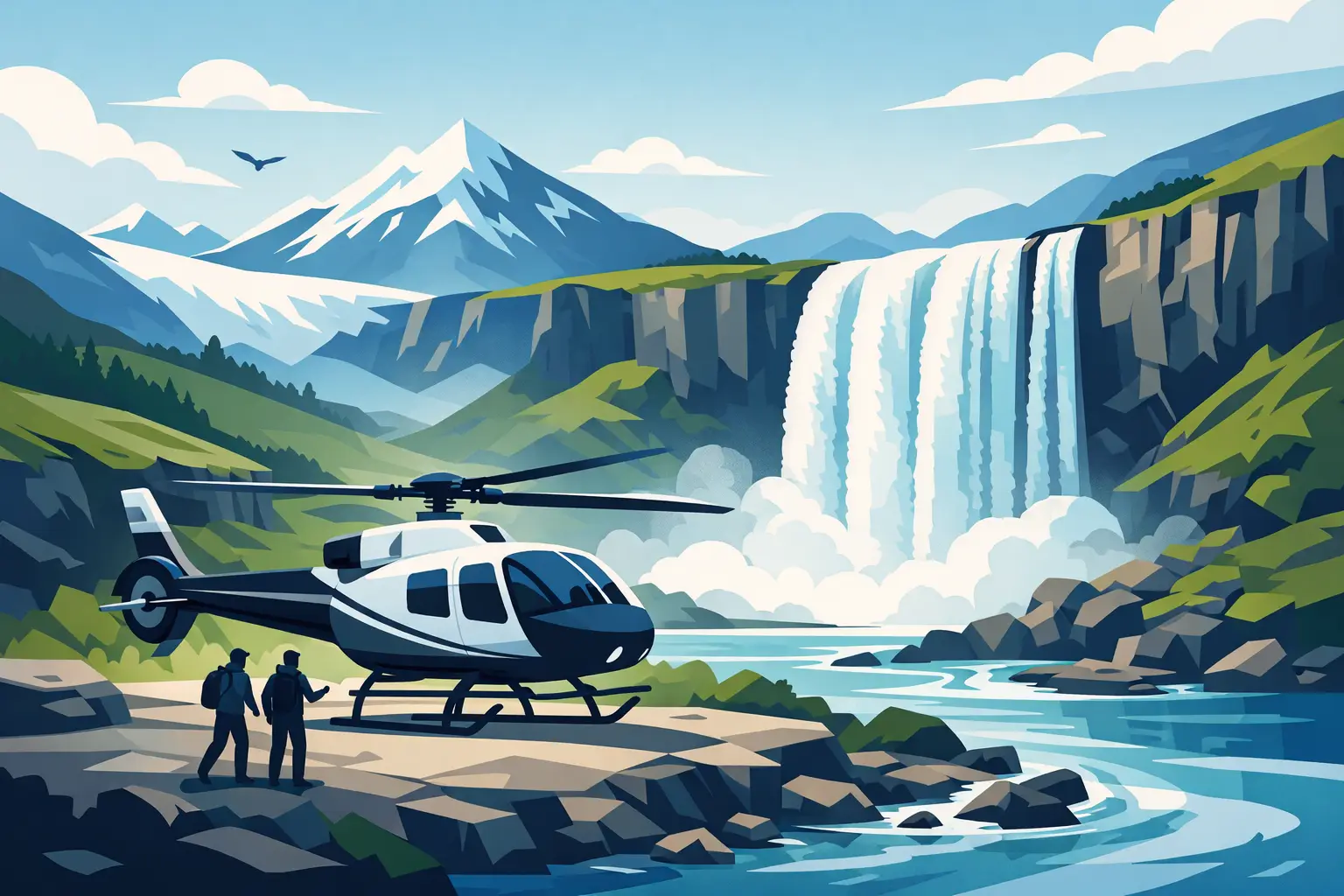
A waterfall landing helicopter experience changes the scale of an Iceland itinerary. From the air, river valleys, black-sand plains, lava fields, and glacier-fed channels appear as one connected landscape. Then the helicopter touches down at a carefully selected location, and the view becomes personal: wind across the highlands, the sound of falling water, and no long line of vehicles between you and the scenery.
For private travelers, couples, families, and photographers, it is one of the most rewarding ways to spend limited time in Iceland. The point is not simply to see a waterfall from above. It is to reach a perspective that cannot be planned around a roadside parking lot or a fixed coach schedule.
What a Waterfall Landing Helicopter Experience Feels Like
The flight begins with the lift away from Reykjavík or another departure point, when the city and roads quickly give way to open country. Iceland is particularly dramatic by helicopter because its landscapes change in short distances. A green valley can lead toward a volcanic plateau; braided rivers can run from a glacier toward a dark coast; a single waterfall may be part of a much larger system hidden beyond the road network.
A skilled pilot can shape the route around the conditions and the day’s priorities. You may follow a river toward a canyon, circle a waterfall at a respectful distance, or combine the flight with views of glaciers, geothermal terrain, or the highlands. Each route is different because weather, visibility, and landing suitability are real parts of flying in Iceland.
The landing is the moment that gives the experience its depth. Rather than landing on an exposed cliff edge or in a sensitive area, the pilot selects a safe, permitted site that delivers the best available view and conditions. From there, guests can step outside, take photographs, and experience the landscape without the movement and noise of the aircraft.
A landing near a waterfall can be calm or exhilarating. On some days, the air carries mist and the low thunder of the water. On others, the view opens across miles of rugged terrain, with the waterfall appearing as one feature in a vast, remote landscape. Both are unmistakably Iceland.
Why Helicopter Access Makes a Difference
Many of Iceland’s best-known waterfalls are accessible by road, but the road is only one way to encounter them. Overland travel can take hours, and conditions may limit access during certain seasons. A helicopter makes it possible to see distant terrain in a single flight and spend more of the day where the landscape is at its most compelling.
This matters most for travelers who want an experience built around their own pace. A private helicopter itinerary can allow time for a scenic landing, a quiet moment with a camera, or an additional stop if conditions and flight planning permit. Instead of choosing between a waterfall, a glacier, and a volcanic landscape, a tailored route can bring several elements of Iceland into one memorable journey.
There is also a different visual story from above. Waterfalls are shaped by the land around them. From the air, you can see the river that feeds them, the canyon it has cut, and the mountains or ice cap behind it. That wider view is especially valuable for photographers and travelers who want more than a quick stop at an overlook.
Waterfalls Worth Building Into a Private Flight
The best destination depends on your departure base, season, weather, and how much time you want in the air. Some guests prefer a shorter scenic flight with a single landing. Others choose a half-day or full-day private charter that combines several remote sights.
Háifoss is a powerful example of what makes a helicopter approach worthwhile. Set within a striking highland landscape, it offers a scale that is hard to appreciate from ground level alone. The surrounding river, gorge, and open terrain turn the flight into far more than a direct trip to one waterfall.
Other routes may focus on the south coast, remote highland rivers, or waterfalls viewed alongside glaciers and volcanoes. The right itinerary is rarely about checking off the highest number of names. It is about choosing a route that fits the conditions and gives each guest enough time to absorb the place.
Planning the Right Flight for Your Group
Private helicopter travel is highly flexible, but Iceland rewards sensible planning. Start with what you want the day to feel like. A couple planning a proposal or anniversary flight may prioritize a beautiful, quiet landing and a refined pace. A family may want a balanced route with several big visual moments and minimal driving. A photography group may care most about light, angles, and time on the ground.
Flight duration is the next decision. A shorter experience can provide a dramatic aerial introduction and one carefully chosen landing. Longer flights create more room to reach distant regions and adapt the route around cloud cover or wind. Full-day experiences are ideal for guests who want to combine waterfalls with glacier views, volcanoes, black-sand beaches, or remote highland locations.
The size of your group also shapes the plan. Private charters allow the itinerary to be designed around your party rather than a fixed sightseeing route. That can make a meaningful difference for multigenerational families, travelers with a specific destination in mind, or guests who need an airport transfer connected to a scenic flight.
HeliAir can arrange bespoke helicopter journeys from its Reykjavík and Ólafsfjörður bases, giving travelers access to different parts of the country without forcing every itinerary into the same route. Share the landscapes that matter most to you, the time you have available, and any occasion you are celebrating. The flight plan can then be built around what is realistic, beautiful, and safe on the day.
Weather, Landing Conditions, and Flexibility
A premium Iceland helicopter experience should feel effortless to the guest, but it is supported by careful operational decisions. Wind, cloud height, precipitation, visibility, and terrain conditions all affect where a helicopter can fly and land. The same waterfall can look entirely different from one day to the next.
That is why flexibility is part of the value, not a compromise. If a planned valley is covered by low cloud, a pilot may recommend a different route with clearer visibility and equally remarkable terrain. If wind makes one landing site unsuitable, another location may offer a better and safer experience. A strong itinerary leaves room for that judgment.
Guests should dress for the landing, not only the aircraft cabin. Warm layers, a weather-resistant outer shell, sturdy footwear, and gloves can make time outdoors far more comfortable, even in summer. Icelandic weather can move quickly, particularly in the highlands and near glaciers.
Make the Landing Time Count
There is no need to rush once the helicopter is on the ground. Take a few minutes before reaching for a camera. Listen to the water, notice the direction of the wind, and look beyond the waterfall itself. The best images often come after the first rush of excitement, when you begin to see the lines of the river and the scale of the terrain.
For photographers, communicate your priorities before departure. You may prefer a broad aerial composition, a side angle on the falls, glacier textures, or a landing with enough room to photograph people within the landscape. The pilot can account for those goals while always keeping conditions and operational requirements first.
A waterfall landing by helicopter is not a replacement for every road trip in Iceland. Ground travel has its own pleasures: villages, quiet roadside stops, and the gradual reveal of the landscape. But when time is limited or the goal is to reach farther, a helicopter flight offers something roads cannot – direct access to the country’s most dramatic geography.
Choose a route with room for the unexpected. The waterfall you expected to see may be extraordinary, but the flight often reveals another valley, ridge, or glacier river that becomes the moment you remember most.