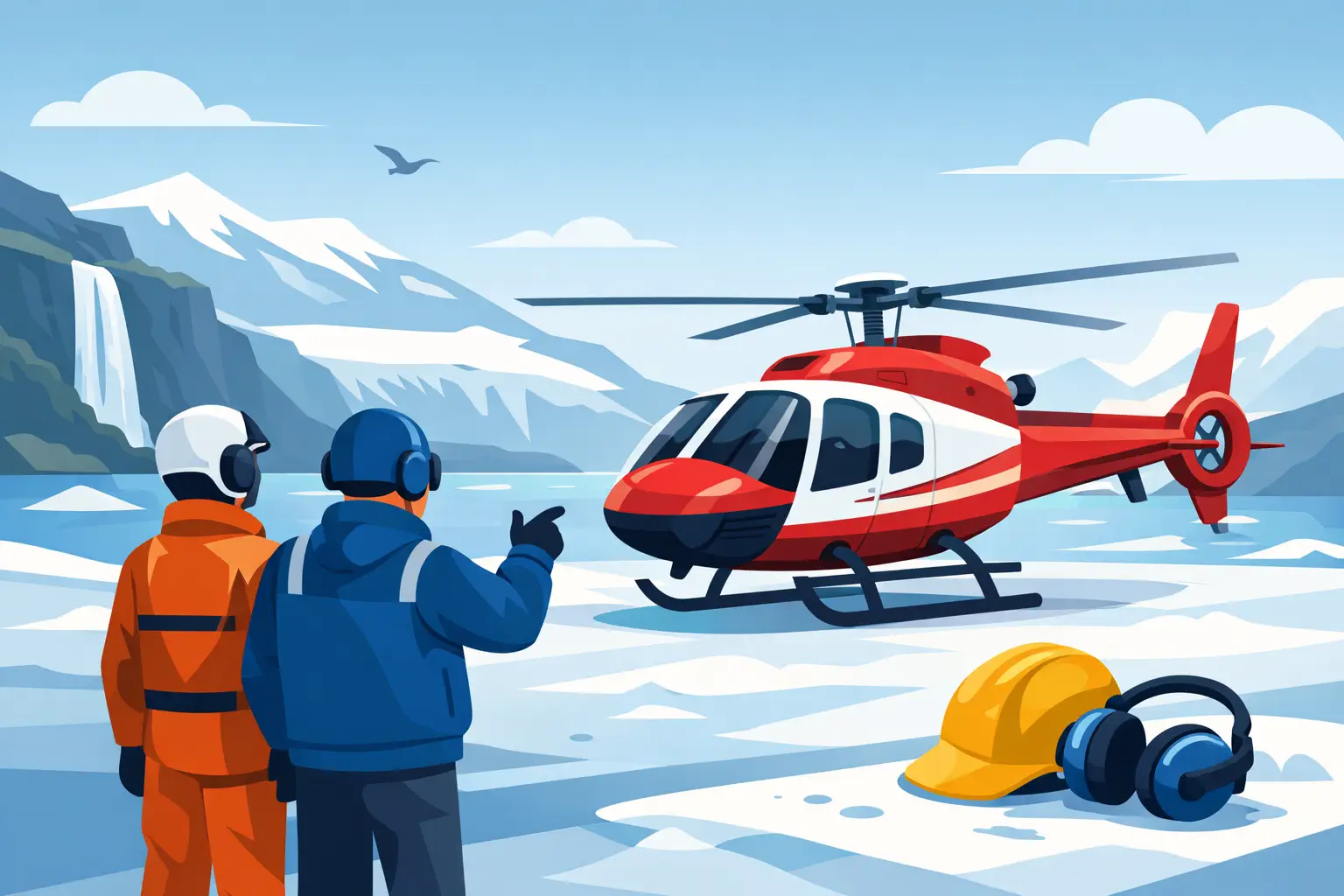
A helicopter can place you above black-sand coastlines, beside a glacier, or on a highland ridge that would take hours to reach by road. That freedom is precisely why helicopter safety standards matter so much in Iceland. A memorable flight is not built on taking chances with the landscape. It is built on disciplined preparation, sound judgment, and a crew willing to change the plan when conditions call for it.
For guests, safety can appear quiet: a careful briefing, a weight check, a delayed departure, or a route adjusted away from a cloud-covered summit. Behind those decisions is a detailed operational process designed to protect passengers, crew, aircraft, and the fragile places where helicopters land.
Helicopter Safety Standards Start Before Takeoff
Safe flying begins well before the rotors turn. Every flight requires a review of the proposed route, aircraft readiness, passenger information, fuel requirements, weather, landing areas, and operational alternatives. For a sightseeing flight, that may mean selecting the best glacier approach or choosing a sheltered valley. For a charter, filming project, or sling operation, planning becomes even more specific around equipment, site access, ground support, and timing.
Iceland makes this preparation especially valuable. Its weather systems can move quickly, and conditions can differ dramatically between Reykjavík, the coast, the interior, and higher elevations. Clear skies at departure do not guarantee clear visibility near a volcano or glacier. Wind direction, cloud base, precipitation, turbulence, and changing light all influence whether a route is appropriate.
A professional operator does not treat the original itinerary as a promise regardless of conditions. It treats it as a carefully designed starting point. The safest route may be different from the planned route, and the safest decision may occasionally be to wait, shorten a flight, select another destination, or cancel.
Weather Judgment Is a Core Safety Tool
Visitors often picture Icelandic weather as an inconvenience to work around. In aviation, it is operational information. Pilots assess more than whether it is raining or sunny. They consider visibility, wind at altitude and on the ground, cloud layers, local terrain effects, freezing conditions, and the forecast trend during the full period of the flight.
Mountainous terrain can accelerate wind and create turbulence along ridges, passes, and glacier edges. Low cloud can obscure the visual references needed to navigate safely in remote areas. A landing site that is comfortable in one wind direction may be unsuitable in another. These are not minor details when a helicopter is operating close to dramatic terrain.
This is where local knowledge matters. Iceland’s landscapes are spectacular because they are exposed, varied, and constantly shaped by natural forces. Experienced crews understand that a route over a waterfall, lava field, or glacier needs to be assessed for the conditions on that specific day, not simply based on a seasonal expectation.
For private travelers, flexibility is part of the premium experience. A custom itinerary should allow room for the pilot to recommend the destination that offers the strongest combination of scenery, comfort, and safe operating conditions. The goal is never merely to fly. It is to fly well.
Aircraft Readiness and Maintenance Matter Every Day
Helicopters are maintained under strict aviation requirements, with scheduled inspections, documented maintenance, and technical checks that occur at defined intervals. Before each flight, the pilot conducts a thorough preflight inspection of the aircraft. This includes examining key systems, checking fuel and fluids, reviewing aircraft documentation, and confirming that the helicopter is ready for the planned mission.
The type of operation also shapes the preparation. A scenic tour has different loading and equipment needs than a point-to-point transfer. Aerial photography may require coordination around camera equipment and flight profiles. Heli-skiing support and external-load work demand mission-specific procedures, specialist crew coordination, and careful site management.
There is a useful distinction for guests to understand: a helicopter may be capable of a route, but capability is not the same as suitability. Safe operations account for passenger load, baggage, fuel, elevation, temperature, landing-site conditions, and the margins needed for the day’s mission. Good aviation decisions leave room for the unexpected rather than operating at the edge of what is technically possible.
Passenger Briefings Are Part of the Flight
A safety briefing is not a formality before an exciting excursion. It gives every passenger the practical knowledge to move safely around the aircraft and enjoy the experience with confidence. The crew will explain how to approach and exit the helicopter, where to wait, how to use seat belts and headsets, and what to do with loose items such as hats, scarves, phones, and camera accessories.
On flights with remote landings, guests should also expect guidance on where they may walk once on the ground. Rotor wash can be powerful, terrain may be uneven, and conditions can change quickly. On a glacier or highland landing, the crew’s instructions take priority over the urge to get the first photograph.
Key passenger practices include:
- Follow the crew’s direction when approaching, boarding, and leaving the helicopter.
- Keep all personal belongings secure, especially lightweight items that can be caught by rotor wash.
- Remain seated with seat belts fastened until instructed otherwise.
- Ask questions before departure if mobility needs, photography gear, or medical concerns could affect comfort or movement.
Families and private groups should share relevant information early. Passenger weights, baggage dimensions, child seating needs, and mobility considerations all help the operator plan accurately. This is not intrusive administration. It is part of matching the aircraft and flight profile to the people on board.
Remote Landings Require Respect for Terrain
Landing in Iceland’s backcountry is one of the defining pleasures of helicopter travel. It is also where planning and discipline become most visible. A suitable landing area needs to be evaluated for surface condition, slope, obstacles, wind, visibility, approach and departure paths, and the safety of people on the ground.
The pilot may decide a site is not appropriate after seeing it from the air. Snow coverage can conceal uneven ground. A previously familiar area may have changed after weather, erosion, or seasonal conditions. Volcanic and geothermal landscapes can present hazards that are not obvious from a distance.
Responsible operations also protect the destination itself. Iceland’s natural areas are remarkably beautiful and often vulnerable. Guests should stay within the area identified by the crew, avoid disturbing wildlife, and leave no trace of the visit. The most exclusive access should come with the highest level of care.
Safety Means Making the Right Call, Even When It Changes Plans
For travelers with limited time, a delay or route change can be frustrating. Yet a company’s willingness to make that call is one of the clearest signs of a safety-first culture. The safest operator is not the one that promises every destination in every condition. It is the one that applies the same standards to a short scenic flight as it does to a complex commercial mission.
That approach includes clear communication. Guests should know that weather-related adjustments are possible, understand what alternatives may be available, and receive practical guidance on clothing, timing, and expectations. For bespoke charters, it also means building contingency into the day rather than treating every minute as fixed.
At HeliAir, the purpose of planning is to make Iceland feel closer without making its terrain seem predictable. A flight over glaciers, waterfalls, volcanoes, or remote northern mountains should feel effortless to the guest because the operational work behind it is anything but casual.
When you choose a helicopter experience in Iceland, ask about the operator’s weather process, passenger briefings, maintenance culture, and approach to remote landings. Then give the crew the flexibility to use their judgment. The finest flights are not defined by forcing an itinerary through difficult conditions. They are defined by arriving at an extraordinary place with the confidence to fully enjoy it.