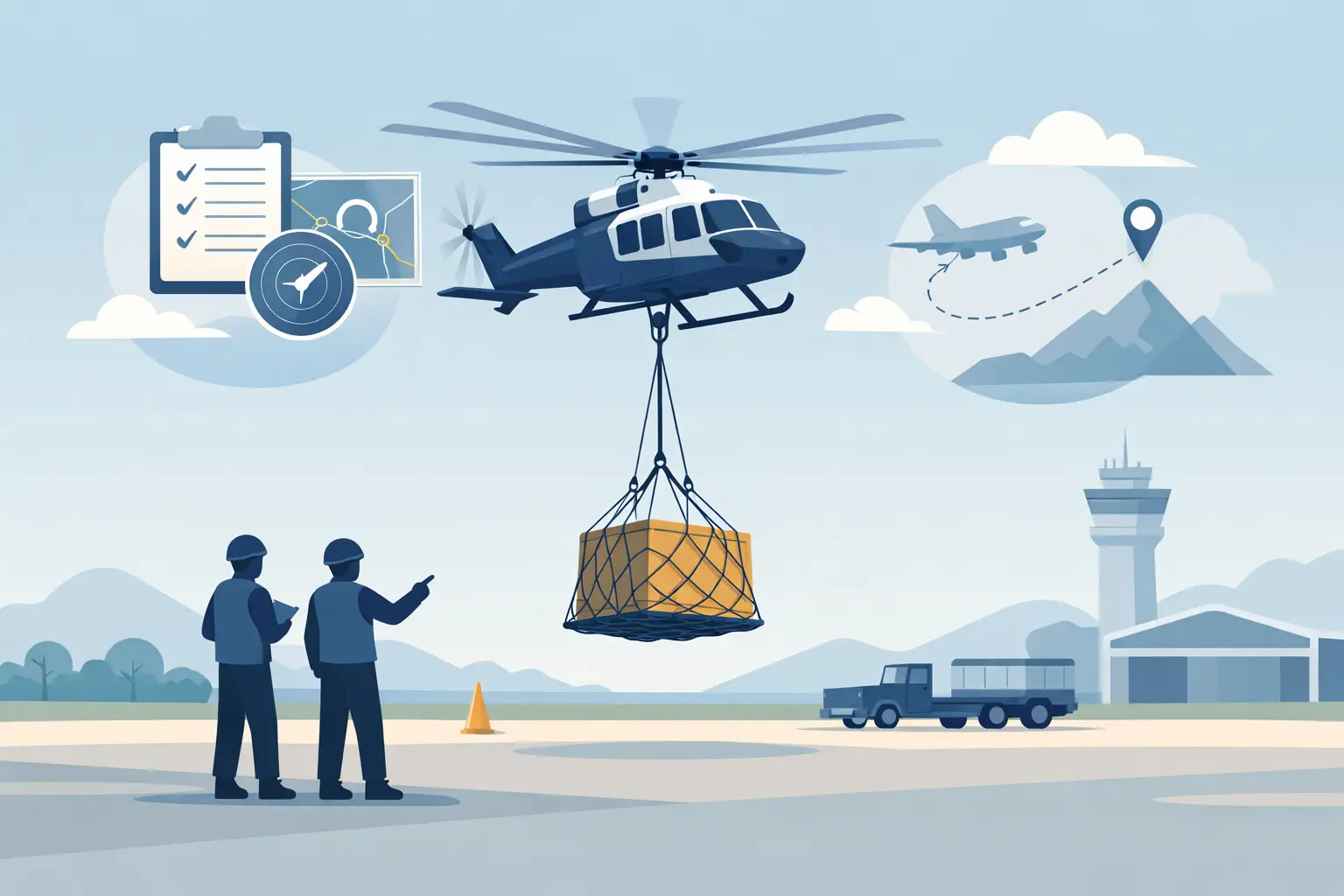
A remote worksite in Iceland can be close on a map and still be unreachable by road. A bridge may be out, a glacier route may be impassable, or a mountain site may need equipment delivered before a short weather window closes. Knowing how to sling load cargo starts with understanding that this is not simply freight attached beneath a helicopter. It is a carefully planned aviation operation in which the aircraft, load, terrain, weather, and ground team must work as one.
For production teams, construction contractors, lodge operators, utility crews, and specialist expeditions, helicopter sling work can reduce days of difficult ground transport to a focused aerial lift. It also carries serious operational responsibility. The right result is not merely getting a load from one point to another. It is delivering it efficiently, without compromising the aircraft, people on the ground, or Iceland’s sensitive landscapes.
How to Sling Load Cargo Begins Before Takeoff
Every safe sling operation begins with a detailed lift assessment. An operator needs to know exactly what is being moved, its verified weight, its dimensions, its center of gravity, and whether it contains fuel, batteries, pressurized items, loose materials, or other restricted cargo. Estimates are not enough. A small change in weight or a poorly secured item can alter the entire lift plan.
The route matters just as much as the cargo. Iceland’s terrain creates real operational variables: steep valleys, uneven lava fields, glacial outwash plains, high winds around ridgelines, and rapidly changing visibility. A load that is straightforward to lift from a level yard may require a different approach at a remote mountain landing area.
The aircraft’s available lifting capability is assessed for the actual conditions on the day, not a brochure figure. Altitude, air temperature, fuel requirements, distance, terrain clearance, and forecast weather all affect what can be carried safely. Sometimes the best plan is one larger lift. At other times, splitting the cargo into smaller, stable loads is the safer and more efficient choice.
The Load Must Be Ready for Flight
A helicopter can only carry a load that has been properly prepared by qualified personnel. Cargo should be packaged, contained, and secured so that nothing can shift, detach, or create debris during flight. Long, broad, or irregular items deserve particular attention because airflow can make them behave very differently from compact equipment.
The rigging system is selected and inspected for the specific cargo and operation. Approved lifting points, compatible slings, hardware, and protective measures are essential. The goal is to create a stable, balanced load that remains predictable from pickup through setdown. If a load is not suitable for external carriage in its current form, it may need a crate, frame, lifting net, or other engineered solution before the flight can proceed.
This is where experienced planning prevents costly delays. A generator, equipment crate, building material bundle, camera platform, or remote-site supply package each presents different handling considerations. The cargo supplier and ground crew should provide accurate specifications early, allowing the operator to identify requirements before the helicopter arrives on site.
Ground Crew Coordination Is Part of the Lift
Sling loading is a team operation. The pilot cannot safely manage the external load, aircraft position, obstacles, and ground activity alone. A trained ground crew is needed at both the pickup and delivery locations, with a clear understanding of roles, communication methods, exclusion zones, and stop-work authority.
Before the aircraft approaches, the site should be checked for loose objects, people, vehicles, animals, overhead wires, unstable footing, and obstacles that could affect the lift. Rotor wash is powerful. It can move lightweight materials, create dust or snow clouds, and make unsecured items hazardous. The loading area should be controlled well before the helicopter arrives.
Only designated, trained personnel should work near the aircraft during load attachment or release. Everyone else should remain outside the established safety area. Crews must also be prepared to pause immediately if communications are unclear, the load is not behaving as expected, or weather conditions begin to deteriorate. A delayed lift is always preferable to a rushed one.
Weather and Terrain Decide What Is Possible
Iceland is extraordinary from the air because it is dynamic on the ground. Weather can change quickly between Reykjavík, the Highlands, the south coast, and northern fjords. Wind direction at the departure point may bear little resemblance to conditions at a remote drop site.
For sling operations, wind affects more than comfort. It can influence load movement, approach options, rotor wash, and the ability to maintain safe separation from terrain. Visibility, precipitation, turbulence, cloud base, and surface conditions must also be evaluated. Snow, volcanic sand, wet ground, and loose gravel can each affect the safety of a pickup or delivery zone.
A professional operator builds flexibility into the schedule. That can mean selecting an alternate landing area, moving at a different time of day, staging cargo closer to the site, or waiting for a safer weather opportunity. Clients should view that flexibility as part of the service, not a setback. In demanding environments, sound decisions are often the difference between an efficient project and an avoidable interruption.
Match the Operation to the Cargo
Not every shipment belongs on a sling. Fragile items, sensitive electronics, unusually aerodynamic objects, hazardous materials, or cargo that cannot be safely rigged may be better suited to internal carriage, road transport, fixed-wing freight, or a combination of methods. The fastest-looking option is not always the best operational choice.
External loads are especially valuable when access is the challenge. They can support remote construction work, utility projects, field research, filming logistics, mountain operations, and deliveries to locations where roads do not exist or would require significant time and disruption. They can also reduce ground impact in areas where driving heavy equipment across fragile terrain is undesirable.
The trade-off is that sling work requires more site preparation and coordination than a conventional passenger flight. Clear cargo information, trained personnel, suitable weather, and approved lift procedures are all non-negotiable. That preparation protects the timeline as much as it protects the people involved.
What Clients Should Prepare Before Requesting a Lift
The most useful first conversation includes the cargo type, confirmed weight, dimensions, photos, pickup point, delivery point, preferred dates, and any site restrictions. It also helps to explain whether the cargo needs to be placed precisely, whether crews will be present at both ends, and whether the job involves multiple rotations.
For commercial projects, allow time for an operational review rather than treating the flight as a last-minute transport booking. Remote locations may require site reconnaissance, weather contingencies, cargo modifications, permissions, or additional ground support. A tailored plan can be built around the project schedule, but it must leave room for aviation realities.
HeliAir supports specialized helicopter operations across Iceland, where each lift is planned around the aircraft, the site, and the purpose of the cargo. Whether the requirement is a single piece of equipment for a remote property or repeated lifts for a technical project, the planning process should be specific to the operation rather than copied from a standard template.
A Better Way to Think About Sling Work
The question is not only how to move cargo beneath a helicopter. The better question is how to create a controlled lift that respects the load, the landscape, and the conditions of the day. When the cargo is properly prepared and the operation is led by qualified aviation professionals, sling work becomes a practical way to reach places that Iceland’s roads cannot.
Bring accurate cargo details to the first planning call, be ready to adapt to the weather, and let the flight team determine the safest configuration. That is how a remote delivery becomes a well-executed part of the project rather than its biggest uncertainty.