Helicopter Sightseeing Versus Boat Tours in Iceland

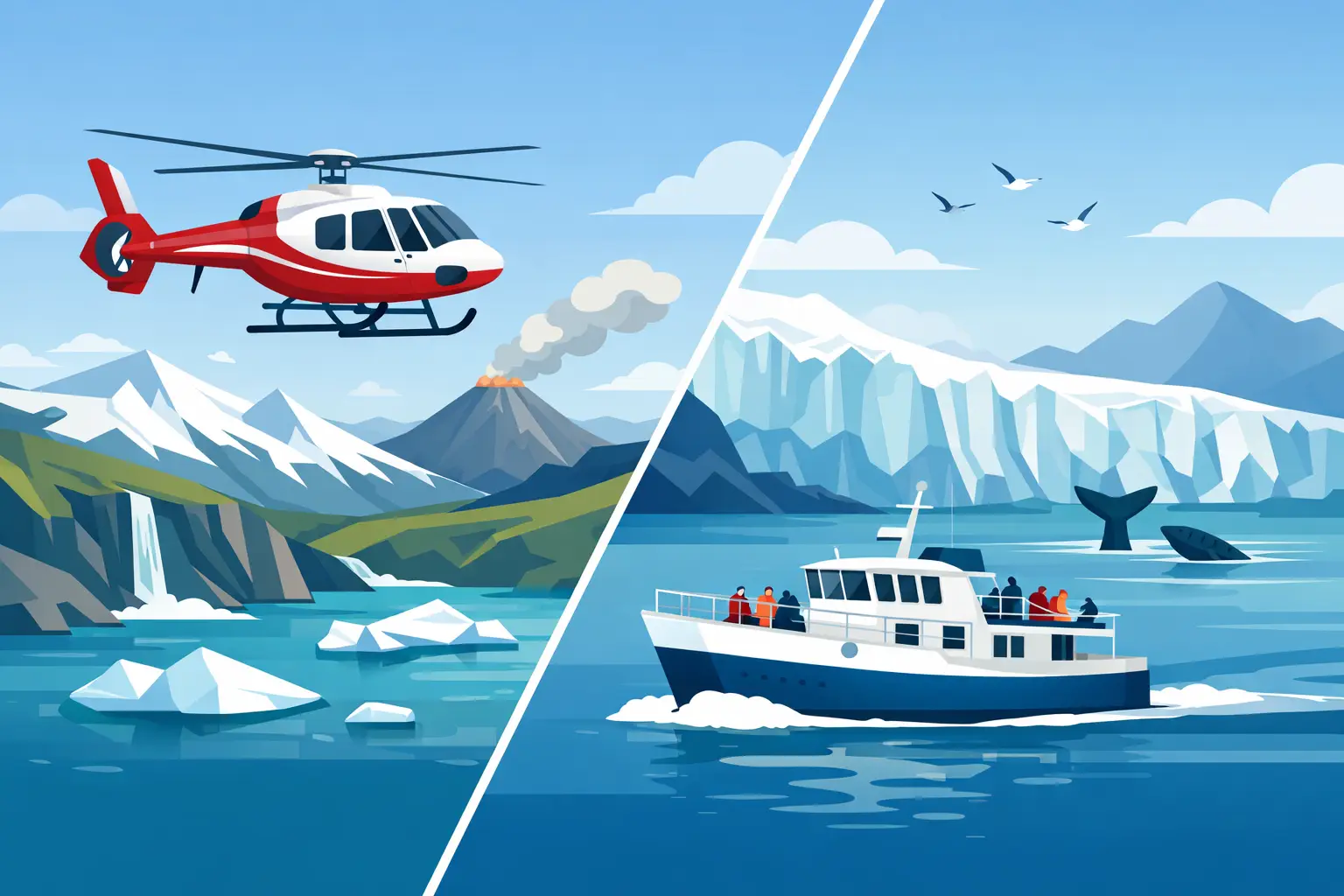
A glacier seen from sea level feels immense. A glacier seen from a helicopter reveals the volcanic ridges, ice fields, black-sand rivers, and hidden valleys that shape the entire landscape around it. That difference sits at the heart of helicopter sightseeing versus boat tours in Iceland. Both can be exceptional, but they offer very different ways to spend a valuable day of a premium Iceland itinerary.

For travelers choosing between the two, the question is rarely which experience is objectively better. It is which perspective matches the place you want to see, the time you have, and the kind of memory you want to bring home.

Helicopter Sightseeing Versus Boat Tours: The Core Difference

A boat tour brings you into Iceland’s coastal world. It can place you close to a drifting iceberg, beneath sea cliffs, or on the waters where whales, dolphins, and seabirds move through the North Atlantic. The pace is measured, sensory, and rooted in a single stretch of coastline or lagoon.

A helicopter journey is designed around range and access. In a short flight, the view can shift from Reykjavík’s colorful streets to lava fields, waterfalls, glacier tongues, volcanic craters, and highland terrain with no road leading into it. Rather than traveling through a landscape one level at a time, you see how its features connect.

That wider perspective matters in Iceland. Waterfalls often begin high on a glacier. Lava flows can run for miles beyond the road. Remote valleys and mountain plateaus may be visible only from the air or after a demanding expedition. A helicopter makes those places part of the experience, not distant scenery.

Choose a Helicopter When Time and Access Matter Most

For visitors with a limited stay, a helicopter can turn a day of driving into a flight measured in minutes. This is especially valuable for private groups, couples planning a milestone trip, photographers working with a narrow weather window, and travelers who would rather spend their time experiencing Iceland than transferring between locations.

A scenic flight also creates possibilities that a boat cannot. Subject to weather, landing conditions, and operational planning, a helicopter may touch down on a mountain, beside a remote waterfall, near a glacier, or in a highland location far from public roads. Stepping out into a quiet landscape after seeing it unfold beneath you is a different experience from looking at it through a boat cabin window.

The aerial perspective is particularly strong for Iceland’s dramatic contrasts. From above, the edge where green farmland meets black volcanic ground becomes clear. Glacial rivers appear braided across the sand. Craters, fissures, and moss-covered lava fields take on scale. For aerial photography, the ability to change altitude, angle, and route is a meaningful advantage.

Helicopter sightseeing is also the more natural choice when the itinerary itself is personal. Perhaps one guest wants a dramatic proposal setting, another wants a highland landing, and the group would like to combine a volcano, waterfall, and glacier in one private outing. A custom flight can be shaped around those priorities far more directly than a scheduled water-based excursion.

Choose a Boat Tour for Marine Wildlife and Coastal Atmosphere

A boat is not a lesser version of an aerial adventure. It is the right choice when the water is the destination.

Whale watching, puffin viewing in season, and the chance to observe marine life at eye level are reasons to choose a boat without hesitation. Wildlife sightings can never be guaranteed, but the anticipation is part of the experience. The movement of the vessel, the salt air, and the long horizon create a sense of being out in the North Atlantic rather than simply viewing it.

Boat tours can also offer close encounters with floating ice in glacial lagoons, depending on the location and season. From water level, an iceberg’s blue channels and sculpted surface are easy to appreciate. The scale feels intimate and immediate in a way that an aerial view does not replicate.

For travelers who enjoy a slower rhythm, a boat excursion provides room to settle into the setting. There is less emphasis on covering distance and more on watching for a whale’s breach, listening to a guide describe the coastline, or waiting as the light changes across the water.

What the Experience Feels Like

The emotional difference is worth considering before comparing prices or duration.

A helicopter flight is exhilarating, efficient, and expansive. The moment of lift-off is part of the appeal, followed by a continually changing view that few other forms of travel can provide. Even familiar landmarks become unfamiliar from above. It is an experience often chosen for a major occasion because it feels distinctly private and difficult to repeat anywhere else.

A boat tour is more immersive in the immediate environment. You feel the weather, hear the water against the hull, and remain close to the wildlife or ice formations you came to see. It can be peaceful, but the North Atlantic is not always calm. Guests prone to motion sickness should be realistic about how they may feel on open water, even with medication or a larger vessel.

Helicopter travel can also involve motion, particularly in changing weather conditions, but it is generally a different sensation from sustained sea swell. Guests with concerns should discuss comfort, mobility, and any medical considerations before booking. A professional operator can help identify the most suitable experience and route.

Weather Changes the Decision

Icelandic weather is part of every outdoor plan, whether the journey takes place by air, land, or sea. Low cloud, wind, visibility, sea conditions, and changing forecasts can affect operations. No responsible company should promise a particular route, landing, or wildlife encounter when nature has the final say.

For helicopter sightseeing, flight plans may be adjusted to find the best available conditions and safest routing. A planned highland landing, for example, may need to change if wind or cloud affects the intended area. This flexibility can still produce a remarkable flight, but travelers should approach the day with an open mind.

For boat tours, wind and sea state are often the defining factors. Conditions may be calm in one harbor and rougher farther offshore. If seeing whales is the central goal, allow room in your schedule for a reschedule where possible. If a boat trip is one part of a broader journey, keep the rest of the day flexible rather than booking it around an inflexible transfer.

The most experienced Iceland travelers do not chase a rigid checklist. They build enough space into their trip to take advantage of the best conditions when they arrive.

Cost, Privacy, and Value

Boat tours are usually the more accessible option in terms of price, particularly on shared departures. They are well suited to travelers who want a memorable marine experience without making it the centerpiece of a luxury itinerary.

Helicopter sightseeing is a premium purchase. The cost reflects aircraft operations, experienced crew, weather planning, landing logistics, and access to places that may otherwise require hours of travel or be unavailable altogether. For a private party, the value often lies in what the flight replaces: long drives, complicated logistics, and the compromise of choosing only one region in a short visit.

A shared scenic flight can be an excellent introduction to Iceland from above. A private charter makes more sense when privacy, timing, photography, family needs, or a highly specific destination matter. It also gives travelers more control over the day, while still respecting operational limits and safety requirements.

A Better Choice Depends on Your Iceland Story

Choose a boat tour if you want to search for whales, feel Iceland’s ocean conditions, or spend unhurried time around a coastline or glacial lagoon. Choose a helicopter if your priority is seeing several landscapes in one remarkable flight, reaching a remote location, or making the journey itself the defining event of your trip.

There is also no rule saying you must choose only one. A whale-watching outing and a helicopter flight reveal two different Icelandic worlds: one shaped by the sea, the other by fire, ice, and altitude. For travelers with time, they complement each other beautifully.

If one experience deserves to be tailored, it is the one that takes you beyond the road. HeliAir can help shape a flight around the landscapes, timing, and level of privacy that make your Iceland journey feel entirely your own.
Best Helicopter Photo Locations in Iceland

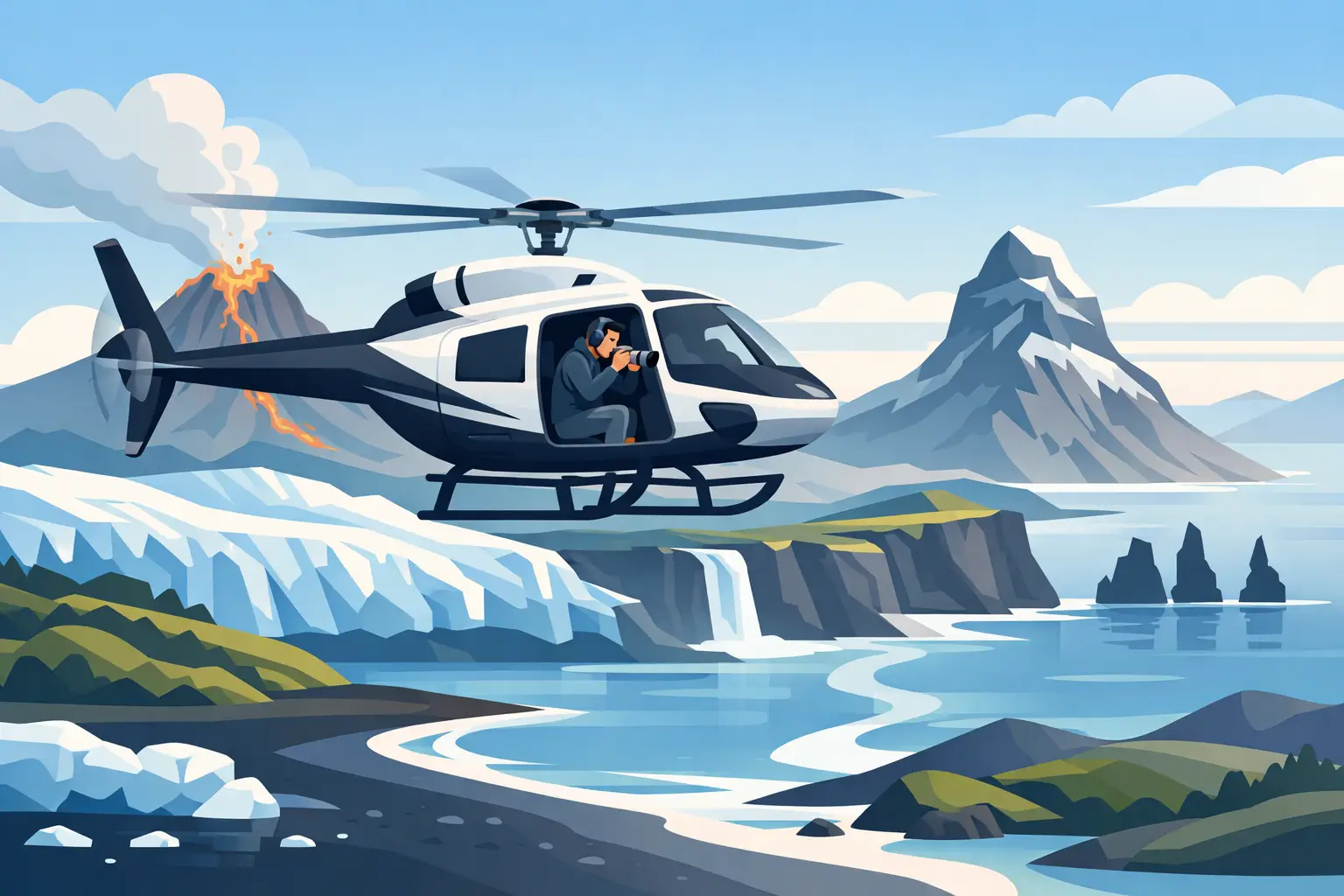
The best helicopter photo locations in Iceland are rarely the ones you can fully appreciate from a roadside pullout. From the air, glacial rivers reveal their shifting patterns, black-sand plains become graphic compositions, and waterfalls show the scale that disappears at ground level. A helicopter also gives photographers something Iceland’s weather often withholds: the ability to reposition quickly when light opens over a different landscape.

For private travelers, couples, families, and production teams, the strongest aerial photo flight is not about checking off the most landmarks. It is about choosing a route with contrast, allowing enough time for changing conditions, and working with a local crew that understands where a safe landing can add a completely different frame.

Best Helicopter Photo Locations in Iceland for Contrast

Iceland photographs best when its elements collide: ice against volcanic ash, bright green moss against dark lava, or white water cutting through a black canyon. The following locations are especially compelling from a helicopter because their shape, scale, and isolation are most visible from above.

Reykjanes Peninsula: Fresh Lava, Ocean, and Geothermal Color

The Reykjanes Peninsula offers some of Iceland’s most immediate volcanic imagery from Reykjavík. Its lava fields, fissured ground, geothermal steam, and Atlantic coastline create an austere palette of black, rust, gray, and deep blue. When volcanic activity or fresh lava is present, access and routing must follow current safety restrictions, but even outside active periods, the peninsula is a powerful study in Iceland’s raw geology.

Photographically, Reykjanes works particularly well in low-angle light. Texture emerges across the lava, steam catches the sun, and the ocean provides a clean horizon beyond the rugged terrain. It is also a practical choice for travelers with a limited schedule, since the landscapes are close to the capital.

Háifoss and the Highland Waterfalls

Háifoss is one of those places where aerial perspective changes the entire photograph. From the ground, the waterfall is dramatic. From above, its position in the broad highland landscape becomes clear: a long river suddenly folding into a dark canyon, with smaller falls and vast open terrain nearby.

A helicopter approach can reveal multiple angles without the long drive and hike required to reach the area overland. The best compositions often include the curve of the canyon rather than isolating the waterfall itself. In softer weather, the surrounding greens and browns carry detail; in sharper sunlight, the contrast between white water and volcanic rock becomes more graphic.

Landmannalaugar and Fjallabak: Color at a Larger Scale

For photographers looking beyond Iceland’s familiar black-and-white contrasts, the Landmannalaugar and Fjallabak highlands offer extraordinary color. Rhyolite mountains shift between ocher, red, green, and charcoal, while braided rivers and lava fields create intricate foregrounds. These are landscapes that reward a wide view.

Conditions matter here. Midday cloud can flatten the mountain colors, while broken cloud and side light bring out ridges, mineral tones, and river channels. A landing, where conditions and permissions allow, can be valuable for environmental portraits or for placing a person in the frame to show the scale of the highlands. The flight itself remains essential for abstract images of the terrain’s patterns.

Þórsmörk and Eyjafjallajökull: Ice, Riverbeds, and Green Valleys

The Þórsmörk valley and the terrain beneath Eyjafjallajökull bring together several versions of Iceland in a single route. Glacial tongues descend from high ice, braided riverbeds spread across dark plains, and mossy valleys sit beneath steep mountain walls. This is one of the most versatile areas for editorial travel photography, engagement shoots, and dramatic landscape work.

The visual character changes rapidly with altitude. Lower approaches emphasize green valleys and winding rivers, while higher routes reveal glaciers, volcanic ridges, and the extent of the surrounding black-sand outwash plains. It is a strong option for guests who want a varied photo collection rather than one dominant subject.

Langjökull and the Interior Ice Fields

Glaciers are not simply white expanses when viewed from a helicopter. Langjökull and other accessible ice fields reveal crevasses, wind-sculpted snow, blue ice, ash layers, and long shadows that are impossible to read from the road. In the right light, the surface becomes almost architectural.

A glacier route is best for photographers who value minimalism and texture. Whiteout conditions can erase the very definition that makes the ice compelling, so flexibility is critical. Clear or partly cloudy skies often provide the strongest result, especially when passing clouds throw moving shadows across the glacier.

Black-Sand Coastlines and Glacial River Plains

Iceland’s south coast is well known from the ground, but the aerial view is where its geometry becomes unforgettable. Black-sand beaches meet powerful surf lines, rivers divide into pale channels across dark sediment, and glaciers seem to spill toward the Atlantic. These scenes are especially effective for high-resolution landscape work and abstract photography.

The best frames may come from a slight angle rather than directly overhead. Oblique views show the river’s movement toward the sea and preserve a sense of depth. Direct overhead compositions, meanwhile, can turn braided rivers into near-abstract artwork. A skilled pilot can adjust the aircraft position to suit the shot, subject to weather, terrain, and safe operating conditions.

How to Plan a Helicopter Photography Flight

A private aerial photography experience should begin with the images you actually want to make. A volcanic landscape, a glacier landing, and a waterfall canyon may all fit within one broader itinerary, but trying to cover too much can turn the flight into a fast sightseeing circuit. Choose one primary visual theme, then add one or two complementary landscapes along the route.

Timing is equally important. Summer offers long daylight hours, greener valleys, and easier access to the highlands. Winter brings lower sun, snow-covered terrain, and the possibility of deeply atmospheric light, but weather windows can be tighter. Spring and fall often provide striking contrast and fewer visitors, although highland access can be more limited.

Build margin into the day whenever possible. Icelandic weather is not a minor detail to manage around. Clouds can obscure a glacier while opening perfectly over the coast, and wind may require a route adjustment or a different landing plan. The best operators treat this flexibility as part of the experience, not a compromise.

A custom flight with HeliAir can be shaped around a desired subject, a specific time of day, or an important occasion. That may mean prioritizing a private landing where practical, spending more time above a particular river system, or combining a scenic route with production requirements. Final routing always depends on conditions, operational approvals, and the crew’s safety assessment.

Photographing From the Aircraft and on Landing

For in-flight shooting, pack light and keep essential equipment accessible. A versatile zoom lens is often more useful than carrying multiple large lenses, since the scene changes quickly and space inside the aircraft is limited. A wide lens captures broad glaciers and mountain systems; a moderate telephoto helps isolate waterfall lines, ridges, and distant volcanic details.

Reflections can affect images through helicopter windows, so wear dark clothing, avoid placing bright items near the glass, and keep your lens close to the window without touching it. If doors-off photography is available and appropriate for the aircraft and conditions, it offers a cleaner result but also requires careful preparation and secure handling of all gear. Your crew will advise on what is possible for the flight.

On a landing, think beyond the obvious panoramic view. Use the helicopter, a traveler, or a photographer in the landscape sparingly to establish scale. In a place as vast as the highlands or a glacier, a small human element can turn a beautiful frame into an image that feels truly personal.

The most memorable aerial photographs come from matching the right landscape to the day you are given. Leave room for the weather, bring a clear creative priority, and let Iceland’s shifting light decide where the strongest image waits.

Remote Lodge Access by Helicopter in Iceland

A remote lodge should feel removed from the ordinary, not difficult to reach. In Iceland, remote lodge access by helicopter can turn a long, weather-dependent ground transfer into a remarkable part of the stay itself: lift off from Reykjavík or northern Iceland, cross black-sand plains and glacial rivers, and arrive close to the landscape you came to see.

For private travelers, families, photographers, and small groups, the appeal is not simply speed. It is the freedom to build an itinerary around a destination rather than the limitations of the road. For production teams and specialist guests, it can also be the most practical way to move people and essential equipment into terrain where driving is slow, seasonal, or simply not an option.

When Remote Lodge Access Changes the Itinerary

Iceland rewards travelers who leave the main route, but many of its most striking areas sit beyond paved roads and regular transfer schedules. Highland lodges, private cabins, glacier-edge stays, and backcountry bases can require hours of driving, river crossings, or travel on rough mountain tracks. In some regions, access changes sharply with the season.

A helicopter transfer compresses that distance while offering a perspective no road journey can provide. From the air, the scale becomes clear: braided rivers cutting through volcanic desert, ice caps stretching toward the horizon, and waterfalls hidden in valleys that few visitors reach. The flight is not a replacement for the destination. It is part of its character.

This is particularly valuable when time in Iceland is limited. A couple arriving from an international flight may want to be at a remote property the same afternoon rather than spend much of the day in a vehicle. A family may prefer a direct, private journey over a demanding overland route. A photographer may need to reach a lodge near a specific landscape while keeping the best light in mind.

There is also a quieter advantage. Arriving by air can preserve the sense of isolation that makes a remote stay special. Rather than passing through busy visitor corridors before reaching the lodge, guests can travel directly from airport, city, or another private destination to the area that matters most to them.

Planning Remote Lodge Access in Iceland

The best helicopter lodge transfer begins with practical details, not a preset route. The location of the lodge, number of guests, estimated baggage weight, preferred departure point, and travel date all shape the aircraft and flight plan. HeliAir can arrange private helicopter travel from its Reykjavík and Ólafsfjörður bases, with custom routing built around the destination and the wider trip.

A lodge transfer may be a simple point-to-point flight, but it can also be designed as a more complete experience. Guests could depart Reykjavík, circle a volcanic landscape or a major waterfall en route, make a scenic landing where conditions allow, and continue to their accommodation. On departure, the route can be different again, perhaps connecting the lodge to an airport, a glacier excursion, or the next stop on a private Iceland itinerary.

Start with the landing site

Not every remote property has the same landing options. Some lodges have an established nearby landing area; others require a suitable site to be evaluated in coordination with the property and local conditions. Ground surface, obstacles, prevailing winds, nearby structures, and environmental considerations all matter.

The ideal landing point is not always at the lodge door. A short vehicle transfer from an appropriate site may be preferable to protect the surroundings and support safe aircraft operations. That small detail should be established before the day of travel, especially for highland and backcountry properties.

Plan luggage realistically

Helicopters are designed around weight and balance, so baggage deserves early attention. Soft-sided luggage is often easier to accommodate than large hard-shell cases, and outdoor gear, camera cases, skis, or production equipment should be discussed in advance. A private charter provides flexibility, but it does not remove aircraft limits.

For guests continuing to a lodge with substantial luggage, there are several possible approaches. The group may travel with reduced overnight bags while larger items go by ground, use a larger aircraft when appropriate, or divide transport between passengers and equipment. The right choice depends on group size, destination, and the kind of stay being planned.

Give the weather room to work

Icelandic weather is part of the adventure, and it deserves respect. Wind, low cloud, visibility, and changing conditions can affect whether a planned route or landing site is suitable. A professional helicopter operator will make decisions based on real conditions, not pressure to follow an itinerary that no longer makes sense.

For this reason, flexibility is valuable. Travelers planning remote lodge access should avoid scheduling an inflexible international connection immediately after a wilderness departure. If possible, build contingency time into the itinerary and keep the first or last night of the trip in an accessible location. In some cases, a different route, a revised departure time, or ground transportation may be the best operational decision.

What the Flight Feels Like

A private helicopter transfer has a different rhythm from a sightseeing tour. There is no need to share the experience with a larger group or follow a fixed stop sequence. The journey is shaped around your party, your destination, and the conditions on the day.

That does not mean every minute needs to be programmed. Some of the finest moments come from looking down at country that has no road through it: moss-covered lava fields, broad glaciers, volcanic ridges, and empty highland valleys. Your pilot can provide local perspective on the terrain and adjust the scenic route when the weather and flight plan allow.

For travelers staying several nights in a secluded property, a helicopter arrival can set the tone immediately. The transition from city, airport, or coastal town to remote wilderness happens in minutes. For a special occasion, it brings a sense of occasion without turning the trip into a performance.

The Trade-Offs Worth Considering

Helicopter access is a premium choice, and it works best when the value is clear. It is ideal for travelers who prioritize time, privacy, landscape access, and a tailored experience. It may be less appropriate for guests traveling with a very large amount of luggage, those who prefer a slower road journey, or itineraries where weather flexibility is not possible.

Ground travel also has its own rewards. A self-drive route allows for spontaneous stops, long walks, and time in small towns along the way. For some visitors, that is exactly how Iceland should be experienced. For others, especially those looking to reach a remote lodge efficiently or make the most of a short stay, the road can consume more of the itinerary than it adds.

The strongest itineraries often combine both. Arrive at a highland lodge by helicopter, then spend the following days hiking, soaking in geothermal water, photographing the changing light, or exploring locally with a guide. Depart by road if conditions and timing suit the plan. Or reverse it: enjoy a scenic drive into the region, then take to the air for a memorable final transfer.

Beyond the Lodge Transfer

Remote accommodation can be the center of a larger private flight plan. Guests may use a lodge as a base for heli-skiing support, glacier exploration, aerial photography, or day trips to landscapes that would otherwise take many hours to reach. Corporate teams and film crews may require direct access for scouting, production, or logistical support, with aircraft capability matched to the mission.

This is where bespoke planning matters. A transfer for two guests celebrating an anniversary is planned differently from a family arriving with outdoor equipment, or a production crew moving cameras and personnel. The destination may be the same, but the operational requirements are not.

The most rewarding remote stay is one that leaves space for Iceland to be Iceland: dramatic, changeable, and far larger than it appears on a map. Choose a lodge that draws you into the landscape, allow sensible flexibility around weather, and arrange the journey so getting there feels as considered as the place you have chosen to stay.

Which Airport Supports Private Helicopters?

A private helicopter flight in Iceland should begin with a practical question: which airport supports private helicopters for the route you have in mind? The answer is rarely just a terminal name. It depends on where you are arriving, where you want to land, the aircraft’s operating permissions, weather, and whether your journey is a transfer, a scenic flight, or a custom expedition into the highlands.

For many private travelers, Reykjavík Domestic Airport is the most natural starting point. It places you close to central Reykjavík and within short flying distance of volcanoes, waterfalls, glaciers, and the dramatic south coast. Keflavík International Airport can also be part of a private helicopter itinerary, particularly when an airport transfer is arranged in advance. The right departure point is the one that matches your arrival schedule and the experience you want to create.

Which airport supports private helicopters in Iceland?

Reykjavík Domestic Airport is the principal airport to consider for private helicopter sightseeing and charter departures in the capital area. Its location is a major advantage. Rather than spending hours leaving Reykjavík by road before the landscape becomes wild, guests can lift off near the city and quickly reach the lava fields, geothermal areas, mountain ridges, and waterfalls that define Iceland’s most memorable scenery.

This makes Reykjavík Domestic Airport especially well suited to private groups staying in Reykjavík, couples planning a special occasion, photographers working to a tight weather window, and visitors who want to make the most of a short stay. A helicopter can turn a full-day ground journey into a focused aerial experience, with time reserved for the places that matter most to you.

Keflavík International Airport serves a different purpose. It is Iceland’s main international gateway, and private helicopter transfers from the Keflavík area can be arranged as part of a tailored arrival or departure plan. For travelers landing after a long international flight, this can replace the usual road transfer to Reykjavík with an immediate view of the Reykjanes Peninsula – a striking region of black lava, ocean coastline, and volcanic terrain.

The distinction matters. Reykjavík Domestic Airport is often the more flexible base for sightseeing flights around southwest Iceland. Keflavík is often most valuable when connecting an international arrival or departure with a private aviation transfer. Airport access, security procedures, baggage requirements, and airside arrangements vary, so these flights should always be planned directly with the operator rather than assumed to be available on demand at the terminal.

A departure airport is only part of the plan

Private helicopter travel is more flexible than fixed-wing travel, but it is not a matter of choosing any open patch of land. In Iceland, landing locations must be suitable for the aircraft, safe for passengers and surrounding terrain, and permitted for the intended operation. A remote waterfall, glacier edge, mountain plateau, or private property may look ideal from the ground, yet operational access can still depend on local rules, surface conditions, wind, visibility, and environmental considerations.

That is why a good charter conversation starts with the destination rather than only the airport. If you want to stand above Þórisjökull, photograph the highlands in evening light, land near a secluded geothermal landscape, or reach a remote lodge, the operator can assess the most suitable departure point and route. Sometimes that means leaving from Reykjavík. In northern Iceland, an operation based near Ólafsfjörður may make more sense for mountain access, heli-skiing support, or northern coastal scenery.

The aircraft, passenger count, luggage, and purpose of the flight also shape the plan. A romantic flight for two has very different requirements from a family tour, a production crew carrying camera equipment, or a commercial sling-work mission. A private helicopter charter is tailored, but the most successful itineraries leave room for operational judgment.

Reykjavík departures for scenic private flights

From Reykjavík Domestic Airport, some of Iceland’s most impressive landscapes are within practical helicopter range. The exact route can be designed around the season, flight duration, weather, and your priorities. One group may want a fast introduction to volcanic terrain. Another may want a longer private flight combining a glacier landing, a powerful waterfall, and a sweeping view of the south coast.

A short private flight can be ideal when your schedule is limited or when you want an aerial perspective to complement other plans in Reykjavík. Longer charters allow more freedom to travel beyond the city’s surrounding landscapes and include carefully selected landings. The appeal is not simply speed. It is the ability to see how Iceland’s features connect: ice fields feeding river valleys, lava flows meeting green lowlands, and black-sand coastlines stretching toward the Atlantic.

Landing is often the moment guests remember most. Conditions permitting, a stop on a mountain, glacier, or remote highland area gives you time to step into a landscape that would otherwise require a long drive and hike. It also changes the pace of the day. Instead of viewing Iceland from a roadside turnout shared with other visitors, you can experience a quieter, wider perspective.

Keflavík helicopter transfers: when they make sense

A helicopter transfer from Keflavík can be an exceptional choice for travelers who value time, privacy, and a memorable first impression of Iceland. The road journey between Keflavík and Reykjavík is straightforward, so a helicopter is not always the most practical choice for every visitor. However, it can be the right choice when you are arriving with a private group, connecting to a yacht or remote itinerary, celebrating a major occasion, or working around a compressed schedule.

The transfer also becomes more compelling when it is designed as more than transport. Depending on the itinerary and conditions, the flight can introduce the Reykjanes Peninsula’s volcanic landscapes before continuing toward Reykjavík or another destination. It is possible to build an arrival experience that feels like the opening chapter of the trip rather than a journey to get through.

There are trade-offs to consider. International arrivals can involve timing uncertainty, baggage handling, border procedures, and airport operating restrictions. Private helicopter transfers should therefore be arranged with realistic time buffers, clear passenger details, and a backup ground plan if conditions change. That planning protects the experience rather than limiting it.

Weather decides the final route

Iceland’s weather is part of what makes the country visually extraordinary, and it is also the reason no responsible operator promises a route without qualification. Wind direction, cloud base, visibility, precipitation, and conditions at both the departure airport and landing area can all affect a flight.

A clear morning in Reykjavík does not guarantee clear weather over a glacier or in the highlands. Likewise, a route that is unsuitable at one hour may become possible later in the day. Professional flight planning accounts for these local differences and may recommend a different landing site, a revised route, a delayed departure, or a reschedule when safety requires it.

For guests, flexibility is the most useful thing to bring. Avoid building a private helicopter flight into the final nonrefundable hour of your visit if you can. When your itinerary allows a weather window, the operator has more opportunity to create the flight you came for. Dress warmly in layers, even in summer, and choose footwear suited to uneven natural surfaces if a landing is planned.

How to choose the right helicopter departure point

Start with where you will be staying and what you want from the flight. If you are based in Reykjavík and want a scenic tour, proposal flight, glacier landing, or bespoke day in southwest Iceland, Reykjavík Domestic Airport will often be the logical choice. If your priority is a premium transfer after landing at Keflavík, ask whether an airport-to-city or airport-to-destination helicopter arrangement fits your schedule.

Then share the details that make the plan real: your preferred date, number of guests, luggage, desired flight time, must-see landscapes, and any mobility or filming requirements. If you are traveling in winter, planning a heli-ski operation, or hoping to visit a remote region, mention that early. The best route may begin somewhere other than the airport you first had in mind.

HeliAir plans private helicopter experiences and specialized charter operations around those details, from Reykjavík and northern Iceland bases to carefully arranged airport transfers. The goal is not to sell a generic flight. It is to match the aircraft, weather window, departure point, and destination to the kind of Iceland you want to experience.

A well-planned helicopter journey begins before the rotors turn. Share the places you hope to see, keep your timing flexible, and let local aviation expertise determine the airport and route that will give your trip its best possible view.

Is Iceland Helicopter Travel Safe? What to Know

A helicopter landing beside a glacier, above a black-sand coastline, or near a remote highland waterfall can feel like Iceland at its most untouchable. So, is Iceland helicopter travel safe? With a professional operator, suitable conditions, and sound passenger preparation, helicopter travel is a carefully managed way to access places that are otherwise hours away by road or entirely beyond it.

The honest answer is not that every flight goes ahead regardless of the forecast. Iceland is a place of fast-moving weather, powerful winds, and dramatic terrain. Safety depends on an aviation operator making conservative, informed decisions – including changing a route, waiting for conditions to improve, or canceling a flight when that is the right call.

Is Iceland helicopter travel safe in changing weather?

Iceland’s weather is the central consideration for any flight. A clear morning in Reykjavík can give way to cloud, rain, fog, or stronger winds later in the day, particularly around mountains, glaciers, and the highlands. These conditions are not a reason to avoid helicopter travel. They are the reason experienced local aviation judgment matters.

Professional flight planning begins well before passengers arrive at the heliport. Pilots assess aviation weather reports, visibility, cloud base, wind speed and direction, and the conditions along the route and at intended landing sites. A route toward a volcano or glacier may be adjusted to use a safer approach, substitute a nearby landing area, or focus on a different region with better weather.

For guests, this can mean embracing a degree of flexibility. The exact waterfall, summit, or glacier plateau planned weeks earlier may not be the best destination on the day. Yet a tailored flight has an advantage over a fixed itinerary: when conditions change, there may be another extraordinary part of Iceland ready to be seen from above.

What makes a helicopter tour safe?

A safe flight is not defined by one factor. It is the result of regulated operations, trained crews, maintained aircraft, disciplined planning, and passengers who follow the briefing.

Pilot experience and local knowledge

Icelandic terrain asks a great deal of a pilot. Flights can involve coastal wind patterns, mountain passes, glacier environments, and isolated landing locations where there is no room for casual decision-making. Local experience helps pilots understand how weather behaves in particular areas and when a visually spectacular route is no longer an appropriate one.

Pilots also have final authority over the flight. That can be reassuring for travelers who have planned a once-in-a-lifetime experience. The decision to turn back, reroute, or remain on the ground is not a failure of the experience. It is the safety system working exactly as it should.

Aircraft maintenance and operating standards

Commercial helicopter operators work within aviation regulations that govern aircraft inspections, maintenance programs, flight operations, pilot qualifications, and passenger procedures. Aircraft are inspected and maintained on scheduled intervals, with operational checks performed before flights.

As a passenger, it is reasonable to choose an established operator that is transparent about its flight process and willing to answer practical questions. You do not need to be an aviation expert. Ask what happens if weather prevents the planned route, how landing sites are selected, and what briefing you will receive before departure. Clear answers are a positive sign.

Conservative route and landing decisions

The appeal of a helicopter is its ability to reach Iceland’s remote landscapes. That does not mean every open-looking area is a landing zone. Suitable landing sites are selected with terrain, surface conditions, wind, obstacle clearance, local restrictions, and safe approaches in mind.

Some of the most memorable flights include landings, but the flight does not need a landing at every intended location to be exceptional. If wind, visibility, snow cover, or ground conditions make a site unsuitable, a pilot may choose a different landing area or continue with a scenic overflight. This is one of the trade-offs of traveling in a raw natural environment: flexibility protects both the experience and the people enjoying it.

What passengers can do before and during the flight

Most guests do not need prior helicopter experience. The crew will explain how to approach and exit the aircraft, where to wait, how to use the headset, and how to move around the helicopter safely. Listen closely, especially around the rotor area, and wait for crew direction before walking toward or away from the aircraft.

Dress for the destination rather than the city. Even on a mild day in Reykjavík, a glacier landing or highland stop can be cold, windy, and wet. Wear sturdy closed-toe shoes and warm, layered clothing. Secure hats, scarves, loose straps, and lightweight items. If you plan to photograph the flight, ask the crew about camera handling before departure and keep equipment controlled while boarding.

Share relevant information during booking. Mobility needs, young children, significant medical conditions, and concerns about motion sickness are best discussed ahead of time. Helicopters are generally smooth in suitable conditions, but every passenger has a different comfort level. A thoughtful operator can advise on seating, timing, and whether a particular itinerary is the right fit.

Weight and balance are also part of normal helicopter operations. Passenger and baggage weights may be requested before departure so the aircraft can be loaded correctly. This is routine planning, not an inconvenience, and accurate information matters.

Are Iceland helicopter flights suitable for families and private groups?

For families, couples, and private groups, a helicopter can be an especially practical way to see a great deal of Iceland without spending a full day on the road. A private charter also allows the itinerary to be shaped around the group’s interests, whether that means photography, a proposal, a short glacier landing, or a broader day of waterfalls and volcanic landscapes.

Suitability depends on the individual traveler and the flight profile. Very young children, guests with limited mobility, or anyone uneasy with confined spaces should speak with the operator before booking. A shorter scenic flight may be a better introduction than a full-day highland itinerary. Conversely, travelers with a clear vision for their trip may benefit from extra time, because it gives the crew more options to work around localized weather.

The same planning discipline applies to specialist flights. Airport transfers, aerial filming, heli-skiing support, and sling operations require different procedures, equipment, and risk assessments than sightseeing. An operator with experience across both scenic and technical helicopter work understands that each mission needs its own plan rather than a one-size-fits-all approach.

Questions worth asking before you book

Premium travel should feel easy, but informed guests make better choices. Ask whether the itinerary is weather-dependent, what alternatives may be available if conditions change, and how much notice you can expect if a flight cannot proceed. Confirm cancellation and refund terms before you commit, particularly if your Iceland itinerary leaves little room to reschedule.

It is also useful to ask about transfer timing, total experience length versus flight time, luggage limits, and what you should bring for a landing. If your goal is a particular sight, such as a volcano, glacier, or remote waterfall, describe it clearly. The crew can explain whether the location is realistic for the season and conditions, or recommend an equally striking alternative.

HeliAir plans flights around Iceland’s landscapes and the realities that come with them, from Reykjavík sightseeing to more remote private charters. The best itinerary is not simply the longest route or the most ambitious landing list. It is the one that matches your priorities while leaving room for the pilot’s weather and safety decisions.

A safe Iceland helicopter experience is built on trust: trust in trained crews, in disciplined operations, and in the willingness to let conditions guide the day. Bring curiosity, dress for the elements, and allow Iceland to reveal its best available view.