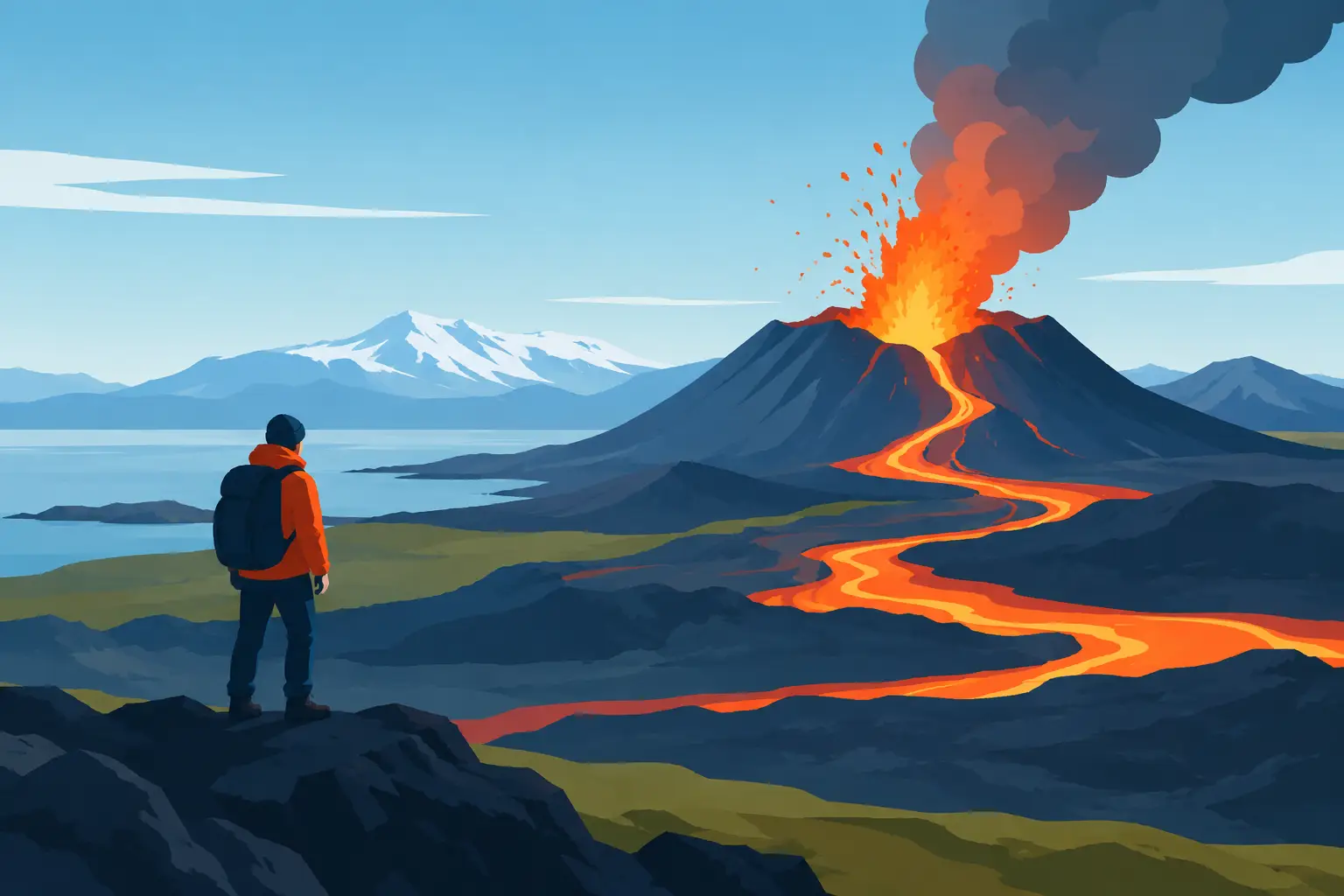
A fresh lava field can look close enough to touch from a map, yet be completely inaccessible on the ground. That is why the question, “are volcano routes active,” has no permanent yes-or-no answer in Iceland. Access changes with seismic activity, gas conditions, road closures, trail safety, weather, and decisions by local authorities.
For travelers planning a premium volcano experience, the better question is: what type of access is possible on the day you want to fly? A current eruption may create extraordinary aerial viewing opportunities while making hiking routes unsuitable. At other times, ground paths may be open to cooled lava fields, but poor visibility can limit a helicopter flight. Iceland rewards flexibility, especially around its youngest landscapes.
Are volcano routes active during an Icelandic eruption?
“Active” can mean several different things. A volcano may be actively erupting, while public hiking trails are closed. A route may be physically open but not advisable because of wind-driven volcanic gas. Roads serving the area may remain open for local traffic but close later if conditions change. A trail that was suitable in the morning can become restricted before the afternoon.
This is particularly relevant on the Reykjanes Peninsula, where recent volcanic activity has drawn visitors to an area that is both remarkably accessible from Reykjavík and operationally changeable. Eruptions in this region can affect roads, utilities, populated areas, and aviation planning. Authorities may establish exclusion zones around a fissure, restrict parking, or redirect visitors away from areas exposed to gas, unstable ground, or emergency activity.
An open route is not the same as a safe route. Iceland’s volcano landscapes are not managed like a fixed attraction with a permanent entrance, marked loop, and predictable operating hours. Conditions are assessed continuously. Travelers should treat every plan involving an active volcanic area as conditional until departure.
What determines access to volcano areas?
The most visible factor is the eruption itself, but it is rarely the only one. Lava can advance across roads or trails, alter familiar landmarks, and create new hazards long after surface activity appears calmer. Newly formed lava fields retain heat beneath a hardened crust, and ground that looks solid can be fragile or dangerously hot.
Gas is another serious consideration. Sulfur dioxide and other volcanic gases can collect in low-lying terrain or travel with the wind. This is not only a concern at the crater or fissure. A route that seems distant from lava may still be unpleasant or unsafe if wind direction changes. Visitors with respiratory conditions should be especially cautious and should never assume a dramatic viewpoint is appropriate simply because it is popular online.
Weather adds another layer. Icelandic wind, low cloud, rain, ice, and limited daylight can affect both driving and flying. A clear forecast in Reykjavík does not guarantee clear conditions around a volcanic site. For helicopter operations, visibility, wind, and the wider airspace picture all matter. For guests, that operational judgment is part of the experience: the objective is not merely to get close, but to do so with a route and altitude that support a safe, memorable view.
Finally, emergency operations take priority. When civil protection teams, scientists, road crews, or utility workers need access, visitor movement may be limited. These restrictions protect both the people working on site and travelers who may not recognize the hazards of an evolving volcanic landscape.
Ground access and aerial access are different
A closed hiking trail does not automatically mean there is no way to experience the volcano. Equally, an active eruption does not guarantee that a helicopter can operate over or near it. These are separate decisions, made according to different risks.
Ground access depends on public safety measures, road conditions, parking capacity, trail conditions, gas exposure, and the status of the exclusion area. It can involve a long walk over uneven terrain, often in changeable weather. For visitors with limited time, young children, mobility considerations, or a preference for a more private experience, that may not be the right format even when trails are open.
Aerial access is assessed through aviation-specific planning. The crew considers weather, visibility, wind, volcanic plume behavior, airspace restrictions, and the ability to operate safely throughout the flight. A helicopter offers perspective that a ground route cannot: the scale of a lava field, the shape of a fissure, the relationship between black lava, moss-covered terrain, and the Atlantic coast. It can also reduce the time spent traveling overland from Reykjavík.
That said, helicopter viewing is not a workaround for official safety restrictions. Responsible operators respect restricted airspace, avoid unsafe plume conditions, and adjust the route when the environment requires it. The best flight may involve viewing from a greater distance rather than approaching the apparent center of activity. From above, that wider perspective is often more compelling anyway.
How to plan a volcano flight without relying on a fixed route
Build your itinerary around flexibility rather than one exact landing point. Iceland’s volcanic activity is part of a living landscape, and the most rewarding plans allow for a change in direction. If conditions near an eruption are unsuitable, a well-designed scenic flight may shift toward glaciers, geothermal terrain, waterfalls, black-sand coastlines, or the highlands, depending on the departure base, weather, and flight time available.
For a private group, this flexibility is especially valuable. A custom charter can be shaped around what matters most to you: aerial photography, a proposal, a family experience, a short addition to a Reykjavík stay, or a longer day of remote Icelandic scenery. Let the flight team know your priorities before departure, but leave room for their local operational judgment on the day.
Timing matters. If volcanic activity is central to your trip, avoid scheduling it as the final, nonrefundable moment of a tightly packed itinerary. A window of several days provides more opportunity to work with weather and changing access. Morning or afternoon may be preferable depending on forecast conditions, seasonal light, and the evolving situation at the site.
It also helps to separate the experience you want from the image you expect. Lava fountains and visible flow are not guaranteed, even during an active eruption. Activity can fluctuate, pause, or occur where ground viewing is limited. Conversely, a recently cooled lava field, steaming fissures, and the raw geometry of a new landscape can make for an exceptional flight without dramatic molten lava in view.
What to expect on the day of your flight
A premium volcano experience begins with practical preparation. Wear layered clothing suitable for Icelandic weather, even if you will spend most of the time in the aircraft. Bring a camera or phone with adequate storage, but keep expectations realistic about window reflections, changing light, and the need to remain seated and secure during flight.
Before departure, expect a route discussion based on the latest available conditions. The crew may confirm the intended volcanic area, suggest an alternative scenic route, or advise that a planned landing is not possible. That is not a reduced experience. It is the difference between a generic tour and a flight planned around real Icelandic terrain.
If the route includes a landing, conditions at the landing site matter as much as conditions at the volcano. Wind, surface conditions, nearby cloud, and safe rotor clearance all influence whether a landing can take place. In some cases, an extended aerial circuit provides the better result. In others, a remote landing far from the active zone creates the ideal contrast: silence on the ground, then a sweeping view of the volcanic region from the air.
Choosing the right kind of volcano experience
The right option depends on your appetite for uncertainty, your time in Iceland, and the type of access you value. A self-drive visit can work well when official routes are open, weather is stable, and you are comfortable walking in exposed terrain. It offers independence, but it also requires close attention to changing notices and the realities of driving in Iceland.
A helicopter experience is best suited to travelers who value time, perspective, privacy, and expert route decisions. It is also a strong choice for photographers and private groups who want to see more of Iceland’s dramatic terrain in one flight. HeliAir can shape a private itinerary around current conditions and the landscapes you most want to see, whether that includes a volcanic zone or a broader scenic route when access changes.
No operator can promise volcanic activity, a particular lava view, or a route that remains open until takeoff. The promise should be better than that: informed planning, clear communication, and a team prepared to make the most of Iceland’s conditions without compromising safety.
Volcano routes are active when authorities and conditions allow them to be, but Iceland’s real advantage is not a fixed path to one viewpoint. It is the chance to see a landscape still being made, with a flight plan ready to follow the best safe view of the day.