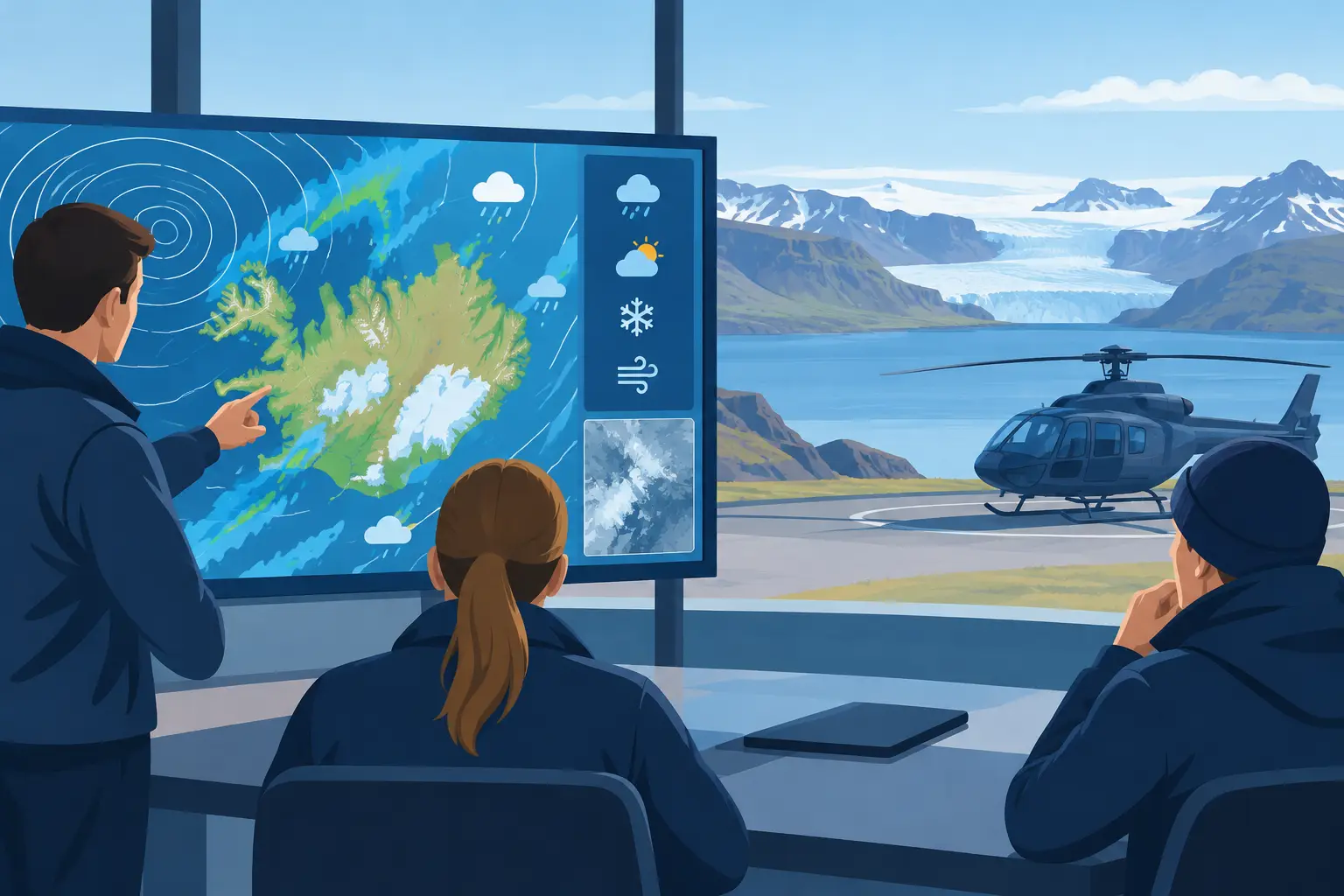
A clear view from Reykjavík can make Iceland feel ready for flight. Then a low cloud layer settles over a mountain pass, winds strengthen around a glacier, or visibility changes across the highlands. That is why understanding how helicopter weather briefings work matters when planning a scenic flight, private charter, filming mission, or remote landing.
For guests, a weather briefing is reassurance that each flight is being assessed with care. For the crew, it is a disciplined operational process: gathering current information, comparing it with the planned route and landing sites, identifying alternatives, and deciding whether the conditions support a safe and rewarding experience.
How helicopter weather briefings work before departure
A helicopter weather briefing begins well before passengers arrive at the heliport. The pilot reviews the latest aviation weather reports and forecasts, then considers the specific flight rather than relying on a broad regional outlook. Conditions suitable near Reykjavík may be completely different at a volcano, a glacier, a waterfall, or a remote ridge only a short flight away.
The briefing considers the planned route, the helicopter’s operating requirements, the terrain, daylight, fuel planning, and the available alternatives. A sightseeing flight that includes a landing needs more than good visibility in the air. The proposed landing area must also be suitable, with manageable wind, adequate visibility, and conditions that allow the helicopter to arrive and depart safely.
In Iceland, that local detail is especially significant. The country’s coastlines, valleys, ice caps, and mountains can create fast-moving variations in cloud, wind, and precipitation. A forecast gives the crew a valuable picture of what may develop, while current observations and the pilot’s local knowledge help shape the decision for the actual flight.
The information pilots evaluate
Weather briefings draw on several types of aviation and meteorological information. Forecasts indicate expected conditions over a given period, while current reports show what is happening now at reporting locations. Satellite imagery, radar, wind information, and localized observations can add useful context, particularly when weather is moving through a region.
The pilot is looking for a practical answer, not simply a sunny or cloudy label. Key questions include whether cloud bases allow safe flight along the intended route, whether visibility is sufficient to maintain visual reference to terrain, whether winds are appropriate for the planned landing locations, and whether precipitation, icing risk, or turbulence may affect the operation.
Wind deserves particular attention in helicopter flying. Wind can be helpful, neutral, or limiting depending on its speed, direction, terrain effects, and the location of a landing site. Air flowing across ridges, through valleys, or around cliffs can behave differently from the general wind reported for a nearby airport. A dramatic mountaintop location may look calm from a distance while conditions on the ground are unsuitable for landing.
Why Iceland requires route-specific weather planning
Iceland rewards flexibility. A route toward the south coast may be clear while the interior is under cloud. A glacier landing may be postponed, while a lower-altitude coastline, lava field, or waterfall remains spectacular and operationally appropriate. The purpose of a briefing is not to force the original plan through changing conditions. It is to find the best safe plan available.
This is one of the advantages of a helicopter experience. Routes can sometimes be adapted to make the most of the day, provided that every change fits within operational limits. A pilot may select a different approach to a destination, choose another landing area, adjust the timing, or recommend an alternate landscape that offers equally memorable views.
That flexibility has limits. Helicopters are highly capable aircraft, but they do not remove the need for good visibility, acceptable winds, or sensible margins around terrain. The most premium experience is not one that follows a fixed itinerary at all costs. It is one that respects the environment and gives guests confidence that the flight is being operated thoughtfully.
Cloud, visibility, and the terrain below
For scenic helicopter flights, the view is part of the mission. Low cloud can obscure mountain slopes, glaciers, and volcanic terrain even when conditions at departure appear favorable. Fog may form near the coast or over wet ground, while cloud can cling to higher terrain and close off a route through a valley.
Visibility is also about more than sightseeing. In visual helicopter operations, the pilot needs a reliable view of the surrounding environment, including terrain, obstacles, and a safe path ahead. Iceland’s landscape is magnificent precisely because it is varied and dramatic. Waterfalls, ridgelines, black-sand plains, ice fields, and steep valleys all demand sound decision-making.
A change in route can therefore be a mark of good planning, not a compromise in service. If one destination is hidden in cloud, another may offer wide-open views and better conditions for an unhurried landing. For private groups, this can be an opportunity to shape the experience around the day rather than a brochure image.
Landing conditions are assessed separately
A landing site receives its own careful assessment. The crew considers surface conditions, wind direction, slope, obstacles, surrounding terrain, and the approach and departure paths. Snow, loose volcanic material, rain-soaked ground, and changing light can all influence what is appropriate.
Remote Icelandic locations are not interchangeable. A glacier landing involves different considerations from a coastal lava field or a highland plateau. Even at a familiar site, conditions can change from one hour to the next. Pilots continually assess the environment rather than treating a previous landing as a guarantee for the next one.
What guests can expect on the day of a flight
Weather decisions are usually made as close to departure as practical, because the newest information is the most useful. Depending on the forecast and the nature of the operation, a team may monitor conditions in the days before the flight and refine the plan again on the morning of departure.
Guests should expect clear communication if weather affects timing, routing, or the ability to operate. In some cases, a short delay allows a weather system to pass. In others, an earlier or later departure offers a better window. When conditions do not support the planned experience, rescheduling or cancellation may be the right decision.
This can feel disappointing when Iceland is the centerpiece of a special trip. Yet weather-related adjustments are part of traveling well in a country where nature sets the terms. Building some flexibility into an itinerary is one of the best ways to protect a private flight, particularly for travelers with a specific glacier, volcano, or remote destination in mind.
For photography and filming, discuss the creative priority before the flight. Is the goal a particular location, low-angle evening light, fresh snow, dramatic cloud, or a broad range of landscapes? A weather briefing can then inform a more realistic operational plan. Sometimes the most cinematic conditions are not bright blue skies, but they must still be safe and workable.
Weather decisions are never made by the guests
Guests are welcome to share preferences, ask questions, and describe what would make the experience meaningful. They may prefer a remote landing, a longer scenic route, or a destination suited to a proposal, family celebration, or aerial photography. Those details help shape the plan.
The final operational decision, however, remains with the pilot and operator. This protects everyone on board and preserves the standard of the experience. No itinerary, schedule, or special occasion outweighs weather limitations or the pilot’s judgment.
That distinction is useful when comparing helicopter experiences. A responsible operator does not promise that every advertised route will fly exactly as pictured on every date. Instead, it combines careful planning with honest communication and, where conditions allow, thoughtful alternatives.
Planning a premium helicopter experience with weather in mind
The most successful Iceland helicopter itineraries leave room for the unexpected. If your schedule allows, consider placing a scenic flight early in your visit so there may be options to adjust the date if needed. Avoid scheduling a fixed onward commitment immediately after the flight, especially for longer custom journeys into the highlands or toward glacier terrain.
It also helps to distinguish between a must-see destination and the feeling you want from the day. A couple may come hoping to land beside a particular glacier, but what they truly want is a private, unforgettable view of Iceland’s wild interior. If conditions redirect the flight toward waterfalls, volcanic landscapes, or a quieter stretch of coastline, the experience can still become the highlight of the trip.
At HeliAir, weather awareness is part of arranging Iceland from above, not an afterthought. Share your ideal route, available dates, group size, and any priorities for landings or photography. With a well-planned window and a willingness to follow the day’s conditions, Iceland often reveals a remarkable route that no road itinerary could offer.